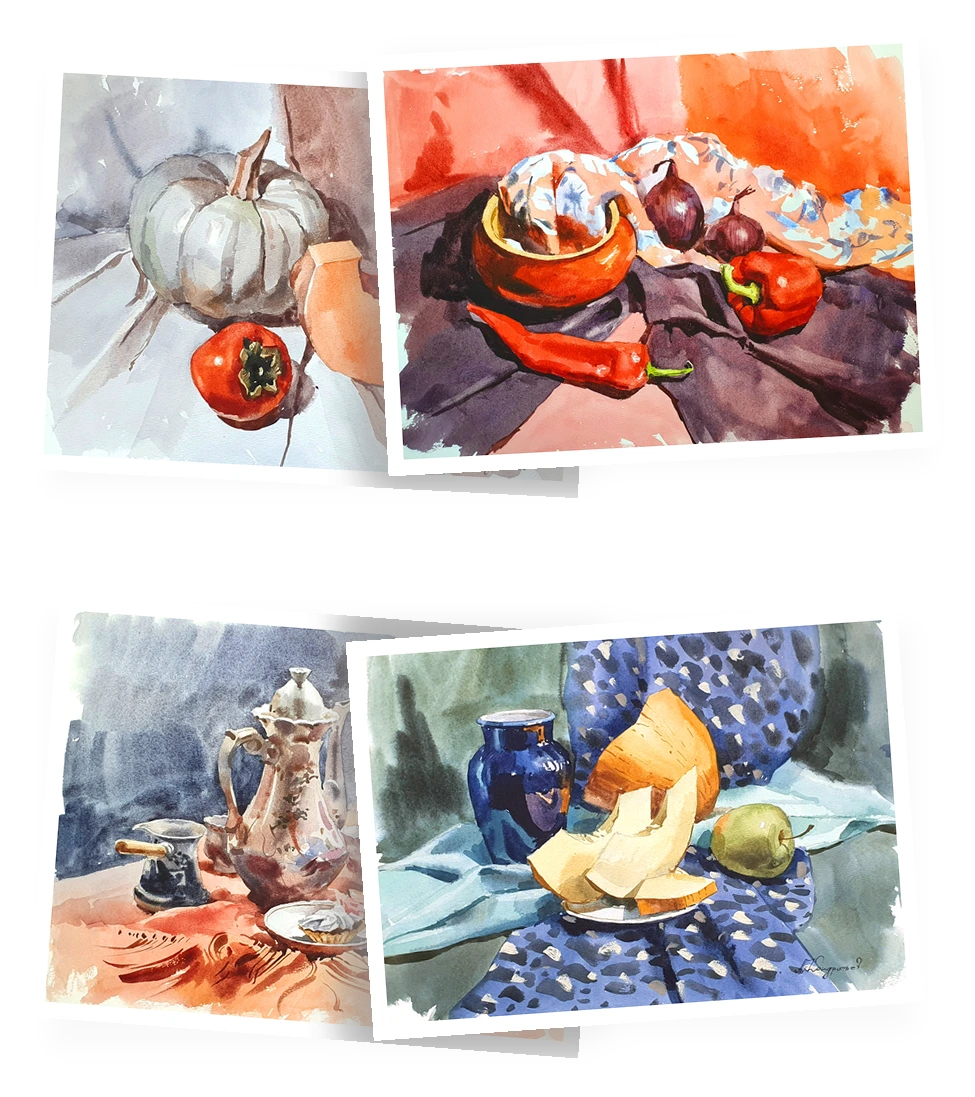
Classical Still Life a course with Alexey Kondratyev
- Paint 8 beautiful compositions featuring fruits, vegetables, and everyday objects
- Learn to capture light, volume, and a variety of textures in watercolor
- Master the fundamental principles of fine art through the still life genre
What the course is about
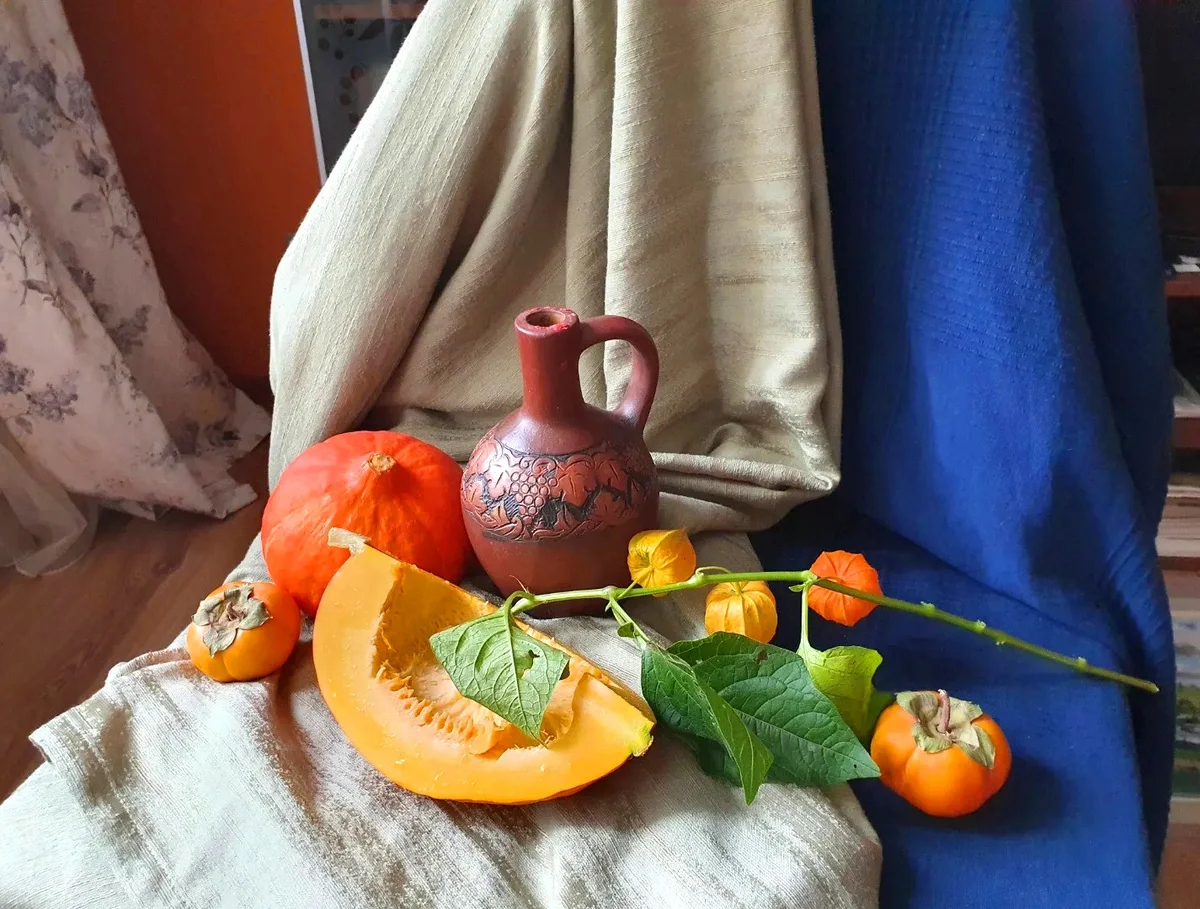
Still life is one of the best genres for developing an artistic eye. It teaches you to see form, color relationships, light, and space — and to understand how objects interact with one another within a single composition.
In this course, we'll build a series of complete watercolor still life setups step by step. You'll master the laws of perspective, learn to convey volume through light and shadow, and work with complex textures and materials: glass, metal, fabric, and fruit. We'll pay special attention to composition and the sequence of working through a painting, so that every stage feels clear and logical.
Who this course is for
This course is a great fit for ambitious beginners who want to dive straight into full still life setups, as well as for those who already have some watercolor experience and are looking to take their work to the next level.
This program is especially valuable for anyone who wants to understand the fundamentals of academic painting and learn to work with color, light, and form with intention — not just guesswork. If it matters to you to understand the logic behind a painting, see your own mistakes, and move confidently from simple tasks to more complex ones, this course will give you a solid foundation for your ongoing creative growth.
Course Program
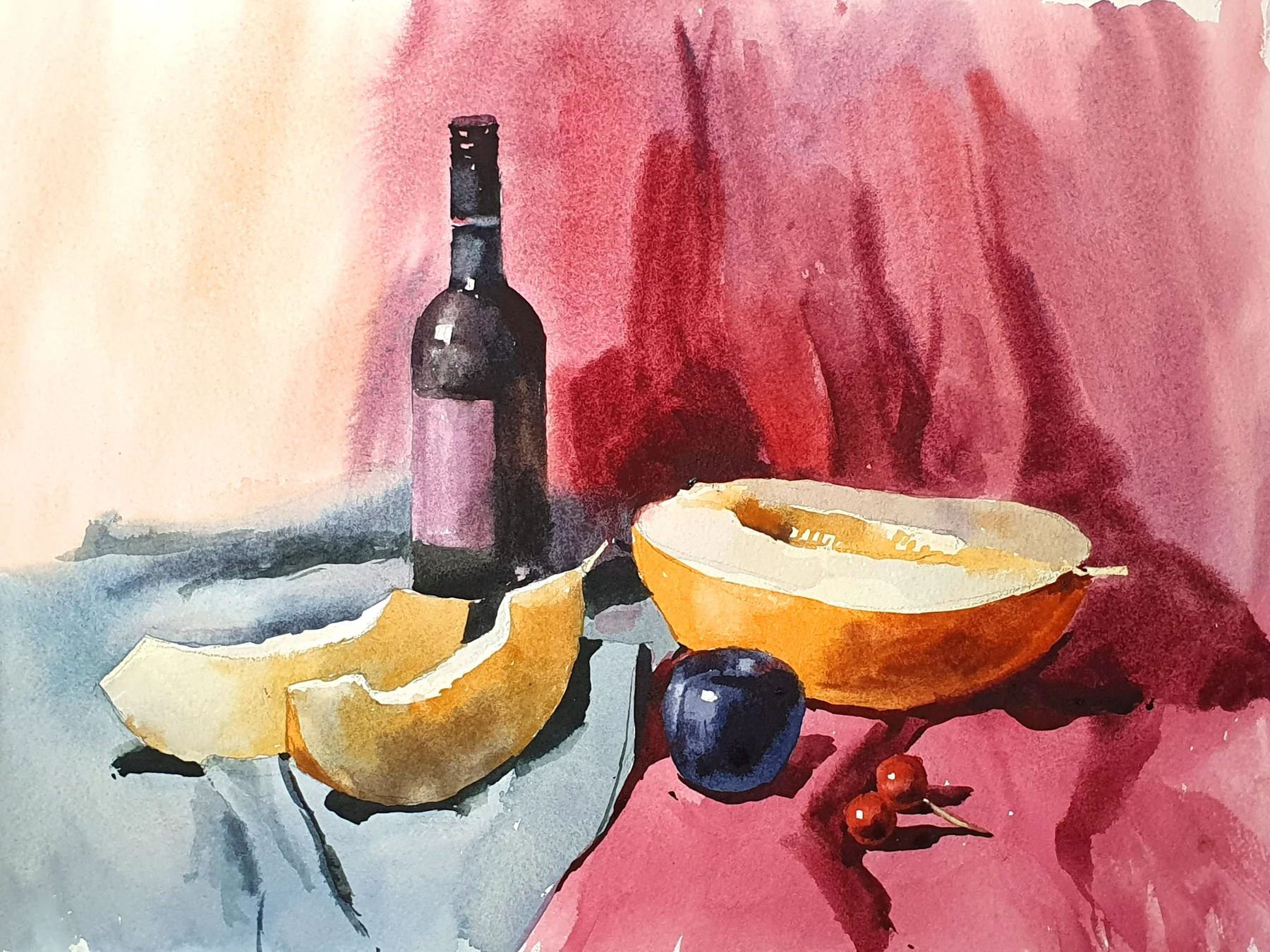
In this lesson we:
- we'll pay special attention to the melon: exploring its shape and color in depth;
- we'll learn to simplify reflected light and reflections, and remove unnecessary details using the bottle as our example;
- we'll explore the importance of tonal contrast and learn to control color saturation;
- we'll learn to mix deep, dark colors without using black pigments.
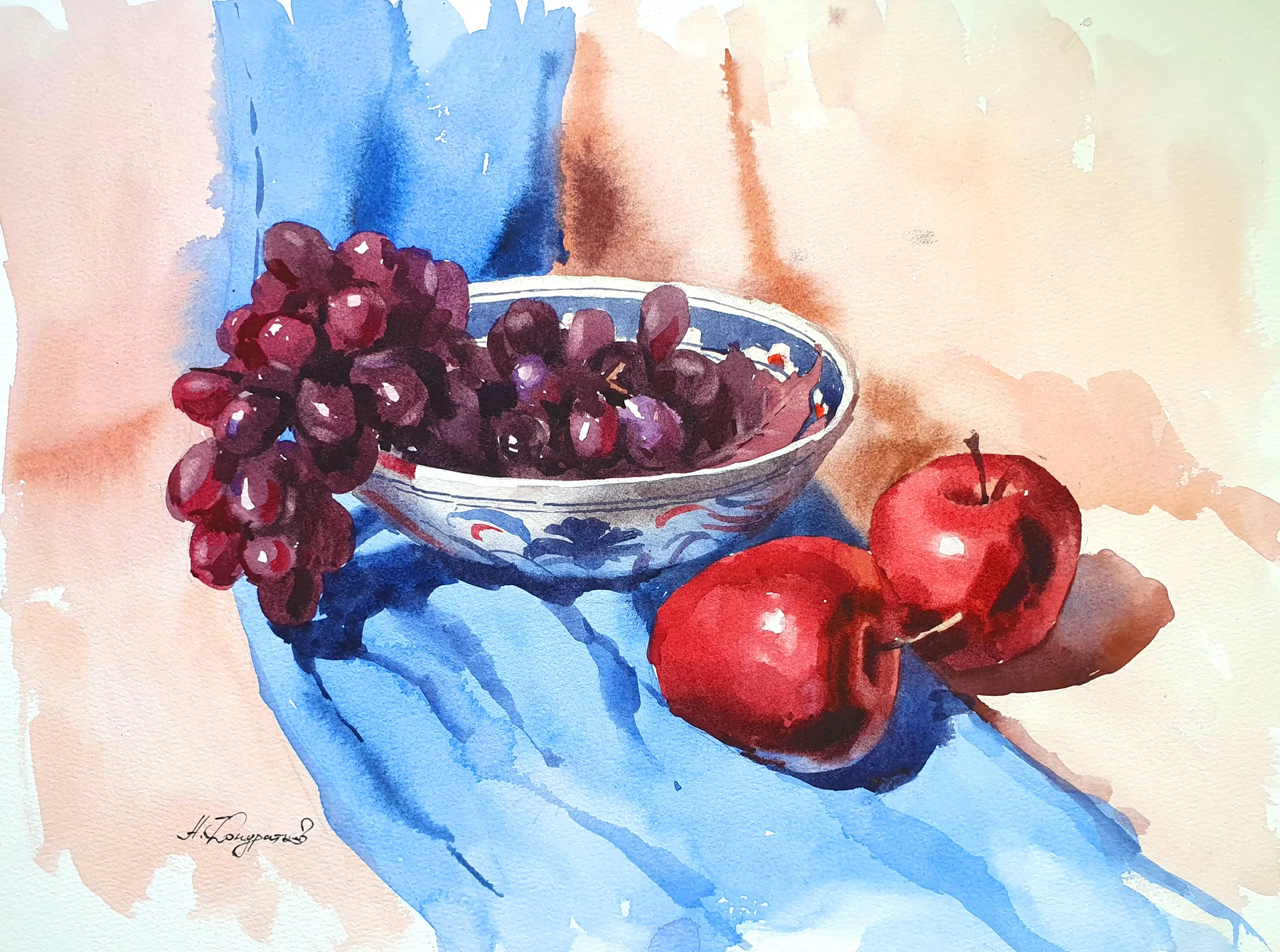
In this lesson we:
- we'll explore one approach to the background (drapery) using the wet-on-wet technique;
- we'll paint two apples using different techniques and discover the role of highlights in building volume;
- we'll learn to paint grapes, simplify the background elements, and bring focus to the foreground ones;
- we'll find out how to paint white objects and work on their ornamentation.
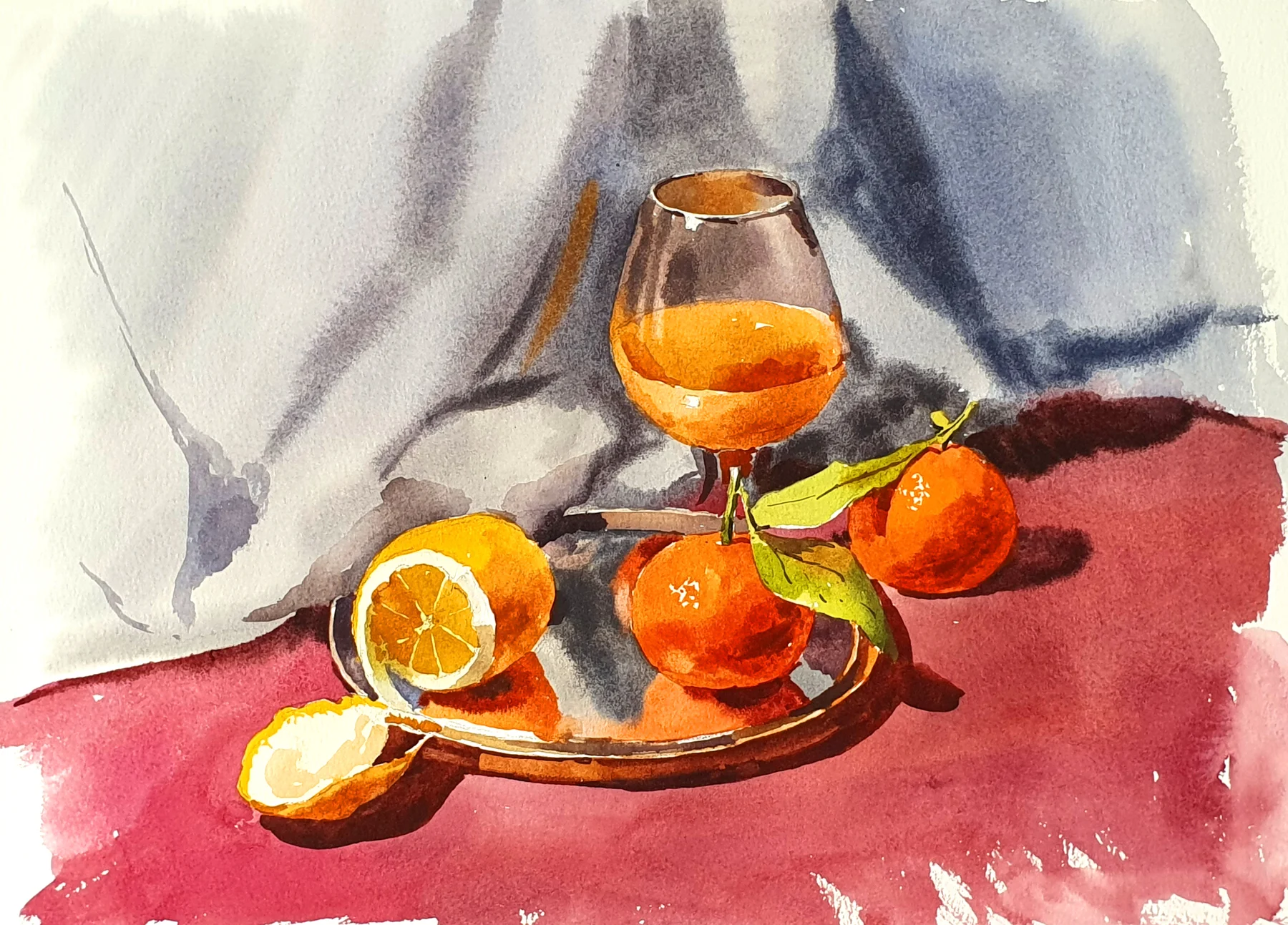
In this lesson we:
- we'll break down light and shadow on the tangerines and learn to sculpt volume with confidence;
- we'll master working with glass and the right layering sequence to convey transparency;
- we'll study techniques for painting reflections in metal and the tonal subtleties they involve;
- we'll talk about how to handle background folds.
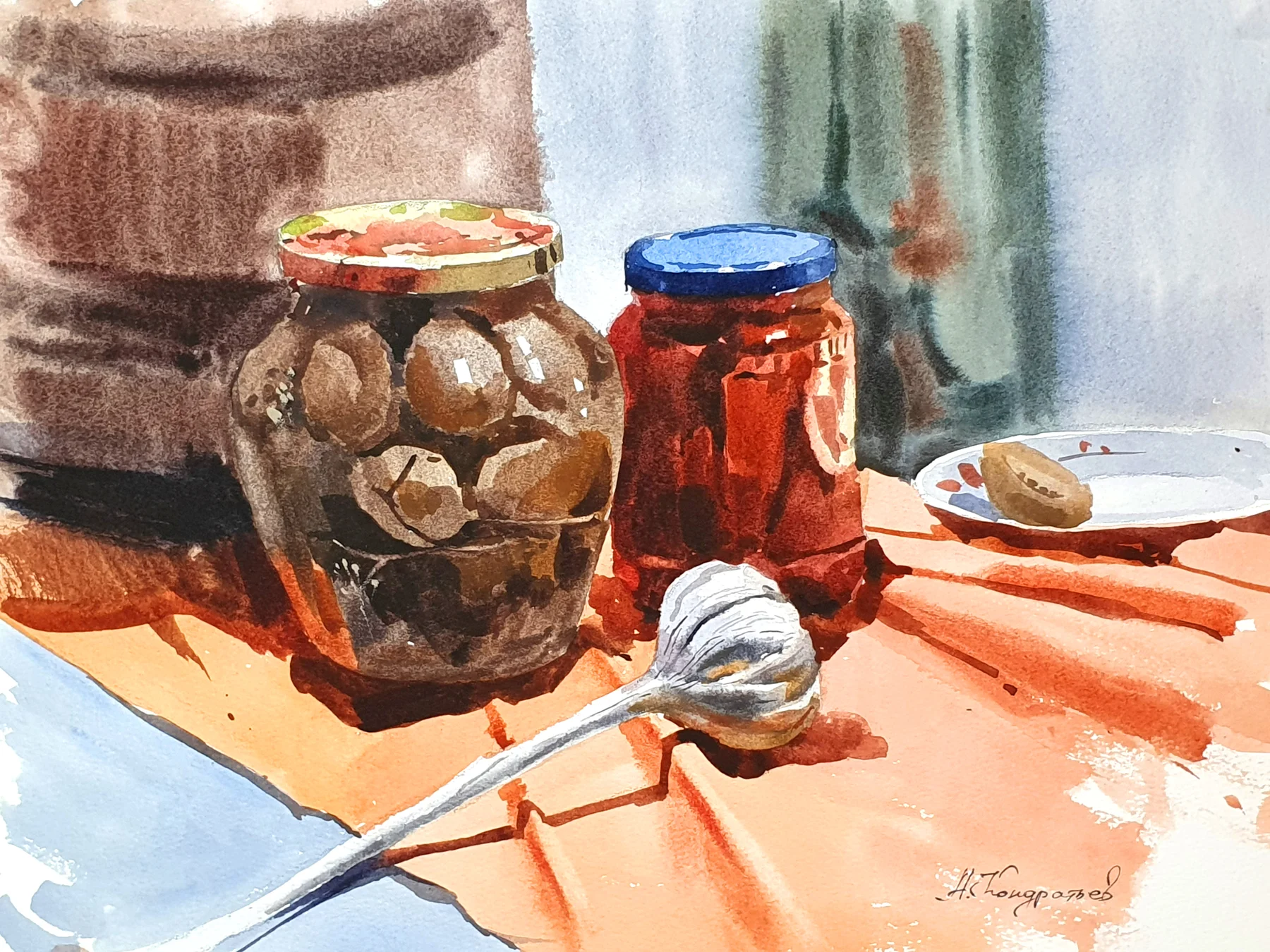
In this lesson we:
- we'll talk about how to control and adjust the composition relative to the reference;
- we'll revisit the steps for constructing cylindrical objects;
- we'll see how to best convey the shape of a jar by ignoring the shapes of the vegetables inside it and keeping the main object dominant;
- we'll learn to convey the space of the still life by working with contrasts.
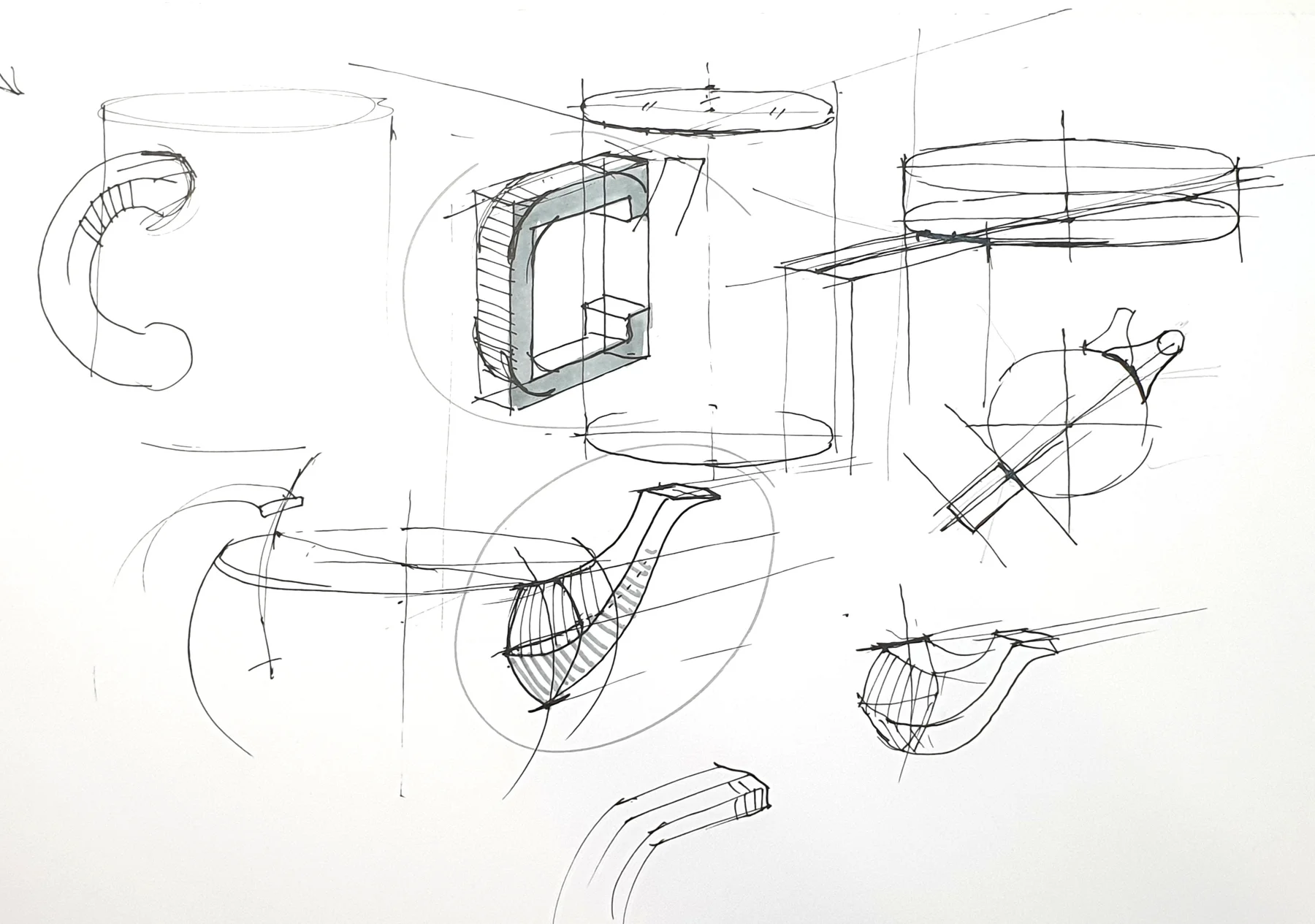
In this lesson we:
- we'll walk through the sequence of working on a still life from the very first steps to the finish;
- we'll do a tonal analysis of the setup and learn to mix the right gray tones using the main palette;
- we'll work on background areas and objects using the wet-on-dry technique and reinforce the rule of taking objects from light to shadow.
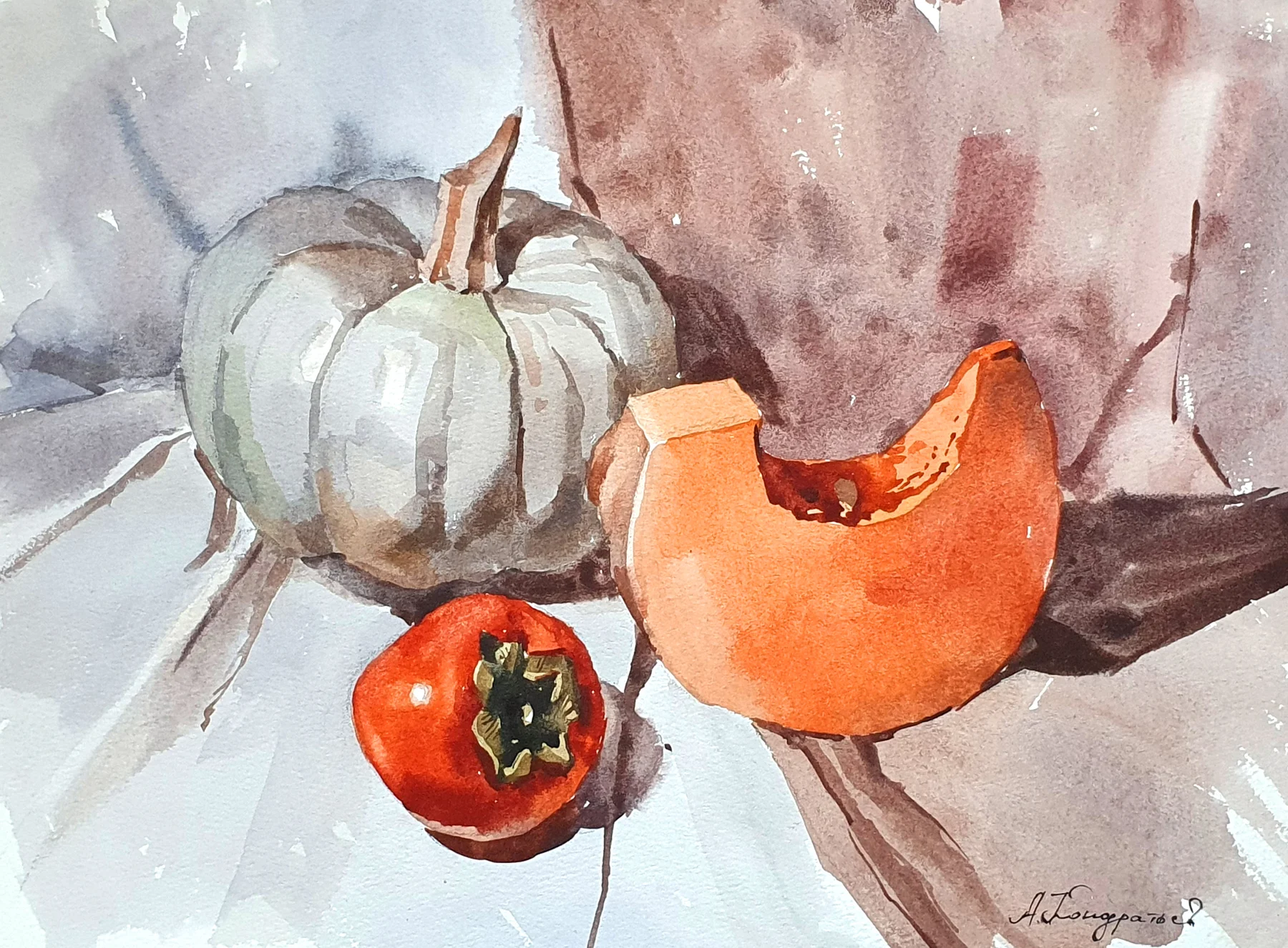
In this lesson we:
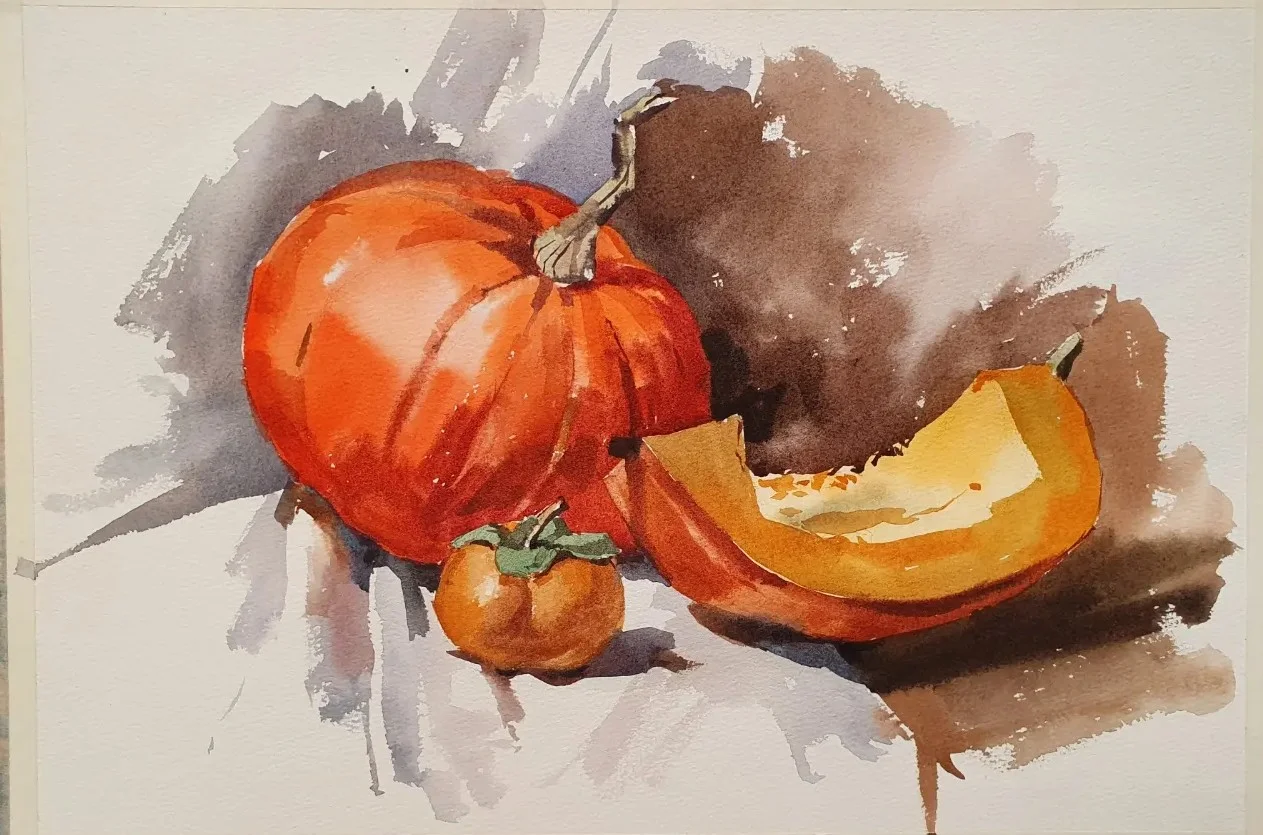
- we'll explore the variety of shades within a single color range and unlock the richness of the red palette;
- we'll analyze the shape of different vegetables and the nuances of capturing their proportions;
- we'll work with color and learn to mix complex, deep shades of red;
- we'll unpack the concept of warm and cool tones and understand their role in creating a realistic sense of volume.
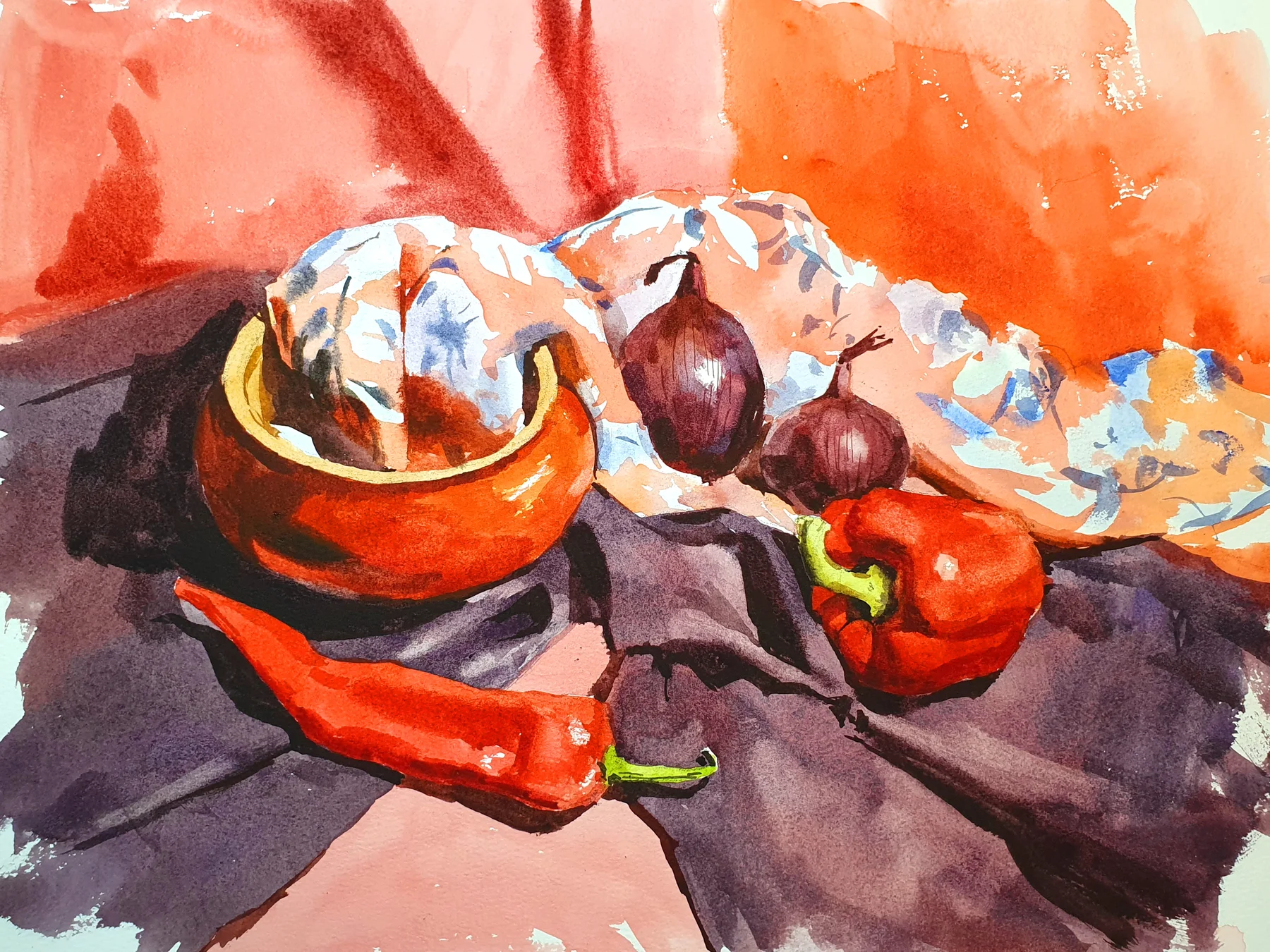
In this lesson we:
- we'll learn how to accurately construct and paint everyday objects with complex shapes;
- we'll work through the painting sequence and naturally integrate an ornament into the volume of the object;
- we'll study graphic techniques for realistically conveying texture, using fabric with fringe as an example;
- we'll learn to boldly simplify secondary elements and place precise visual accents.
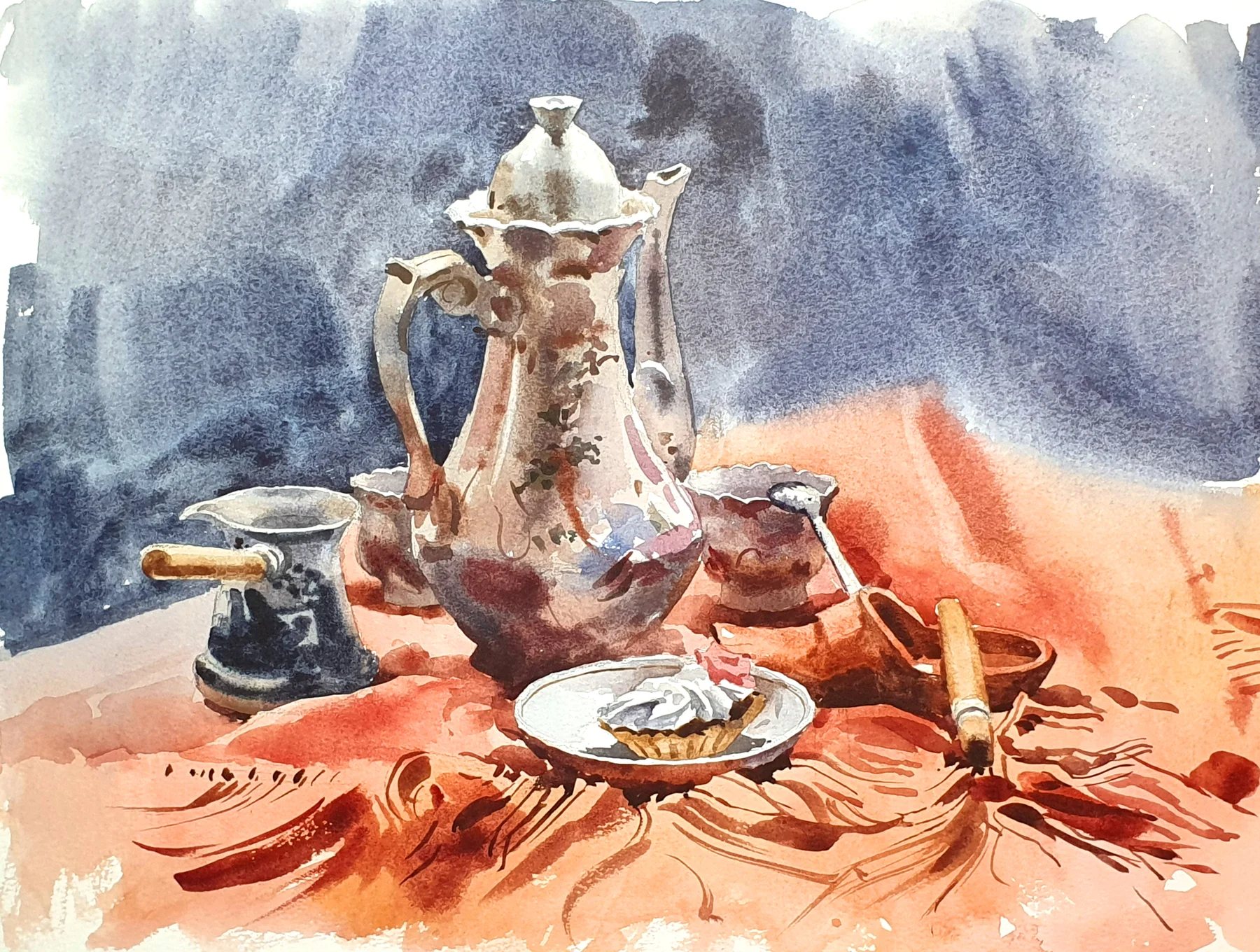
In this lesson we:
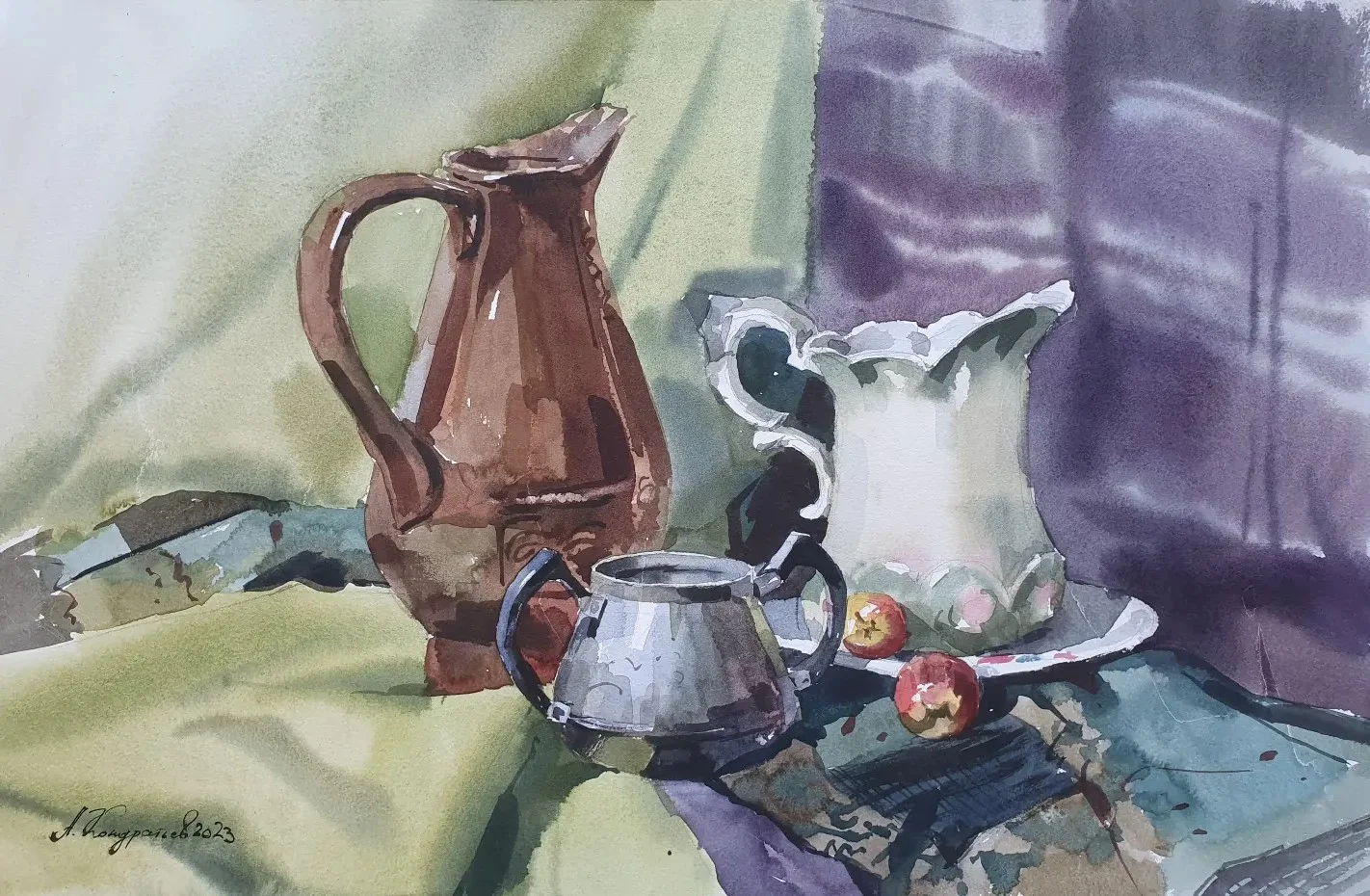
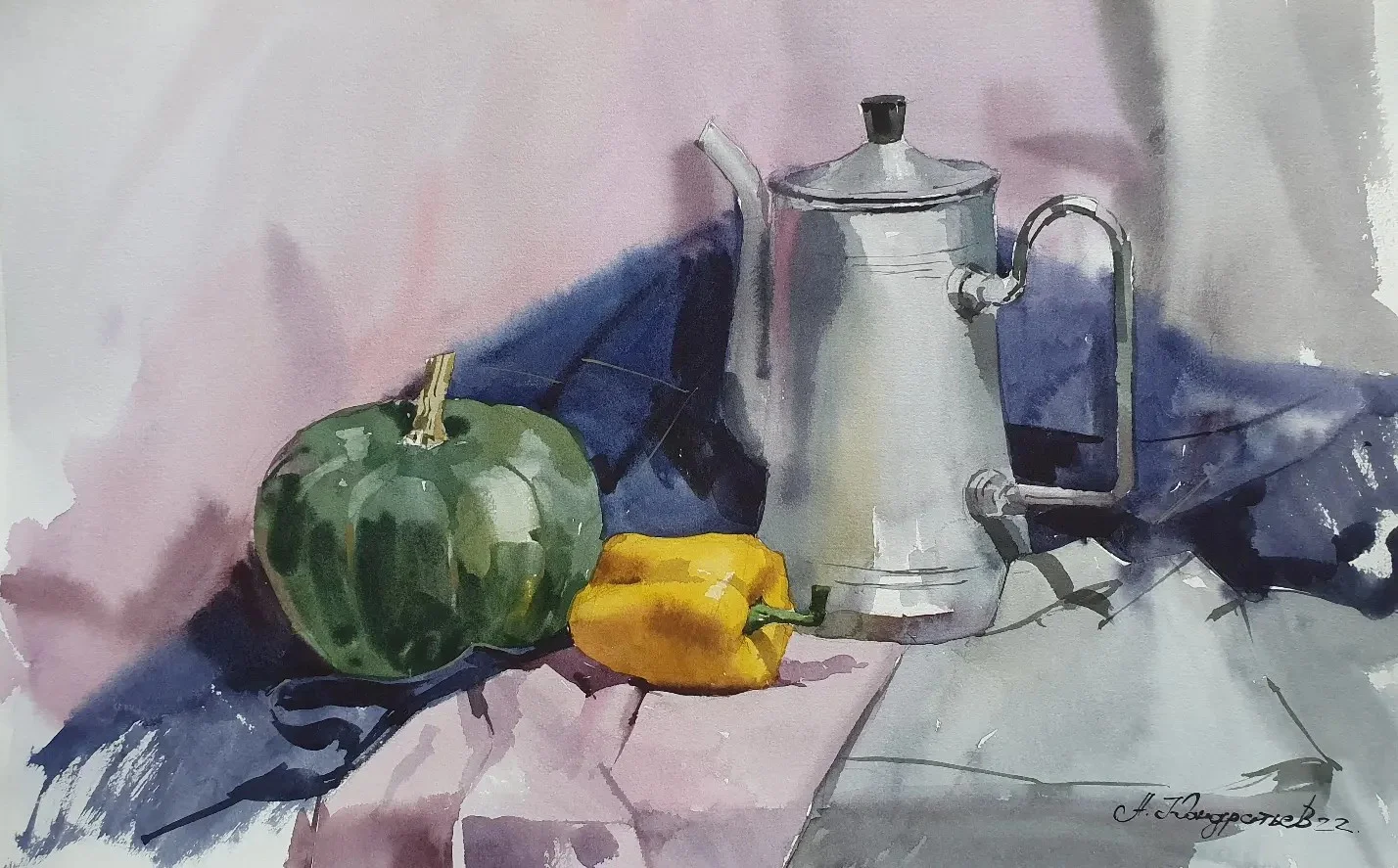
- we'll explore working with glossy surfaces and, using the jug as our example, convey shine through carefully observed reflected light;
- we'll look at one way to approach a multicolored drapery;
- we'll learn to build the volume of objects by controlling the tonal gradations of light and shadow;
- we'll talk about folds and how to use watercolor techniques to paint them.
Course instructor
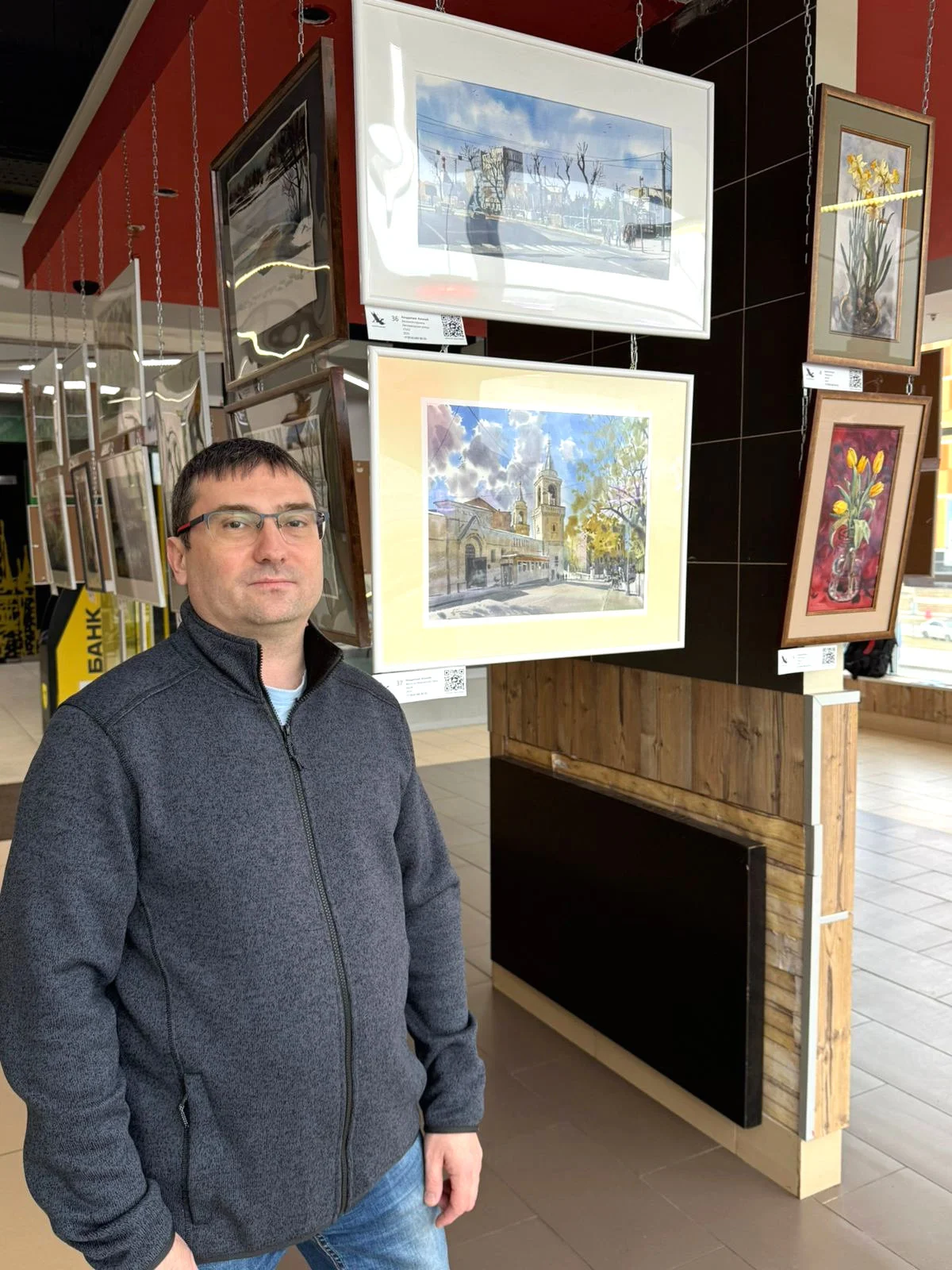
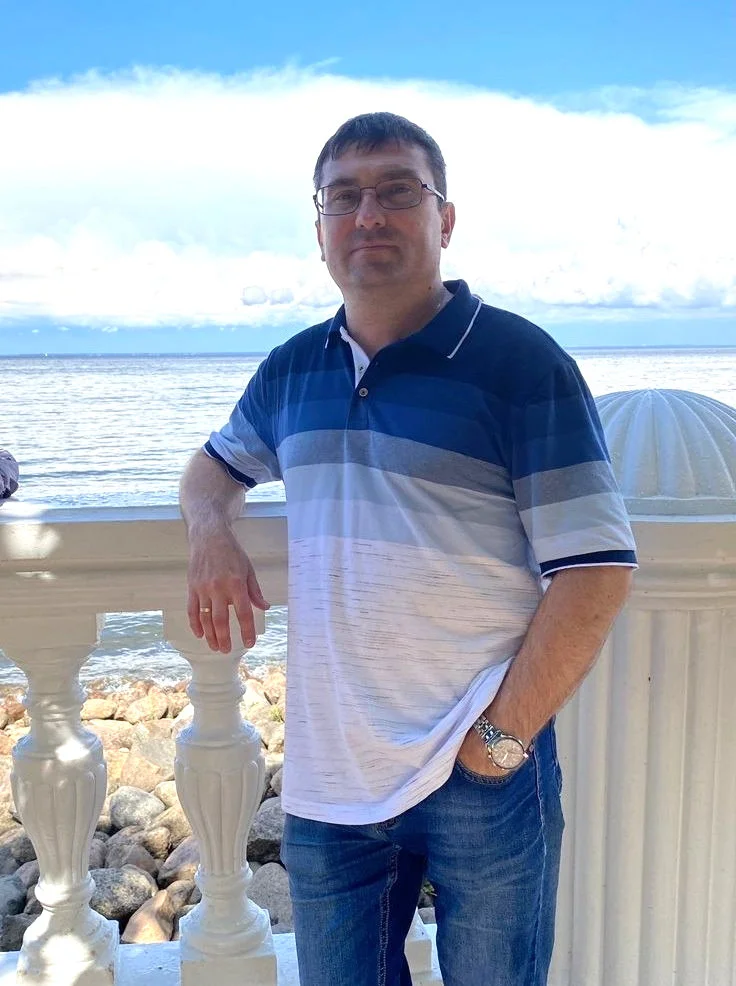
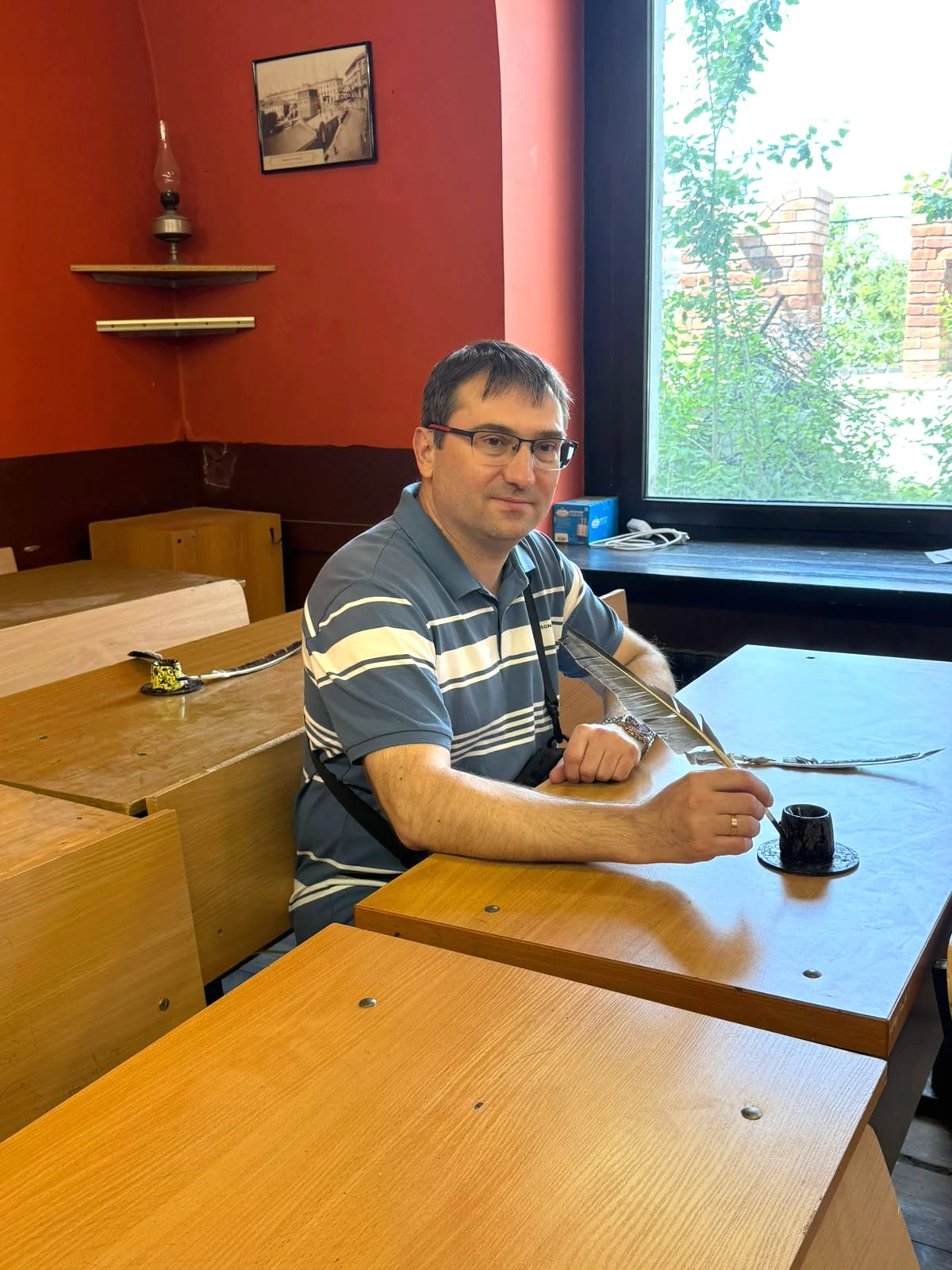
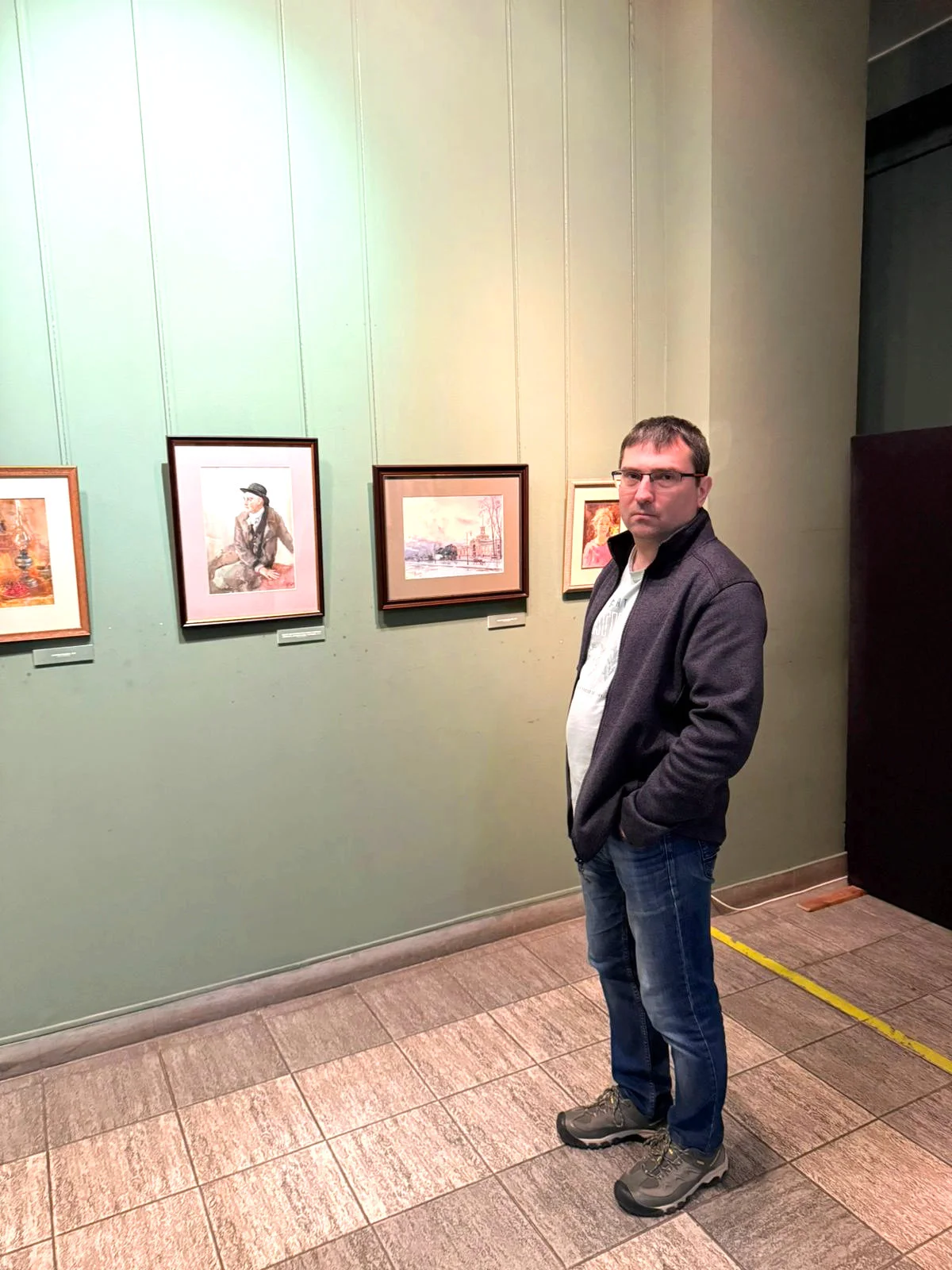
- Watercolor artist with a fine arts and teaching background.
- I've been teaching for over 20 years.
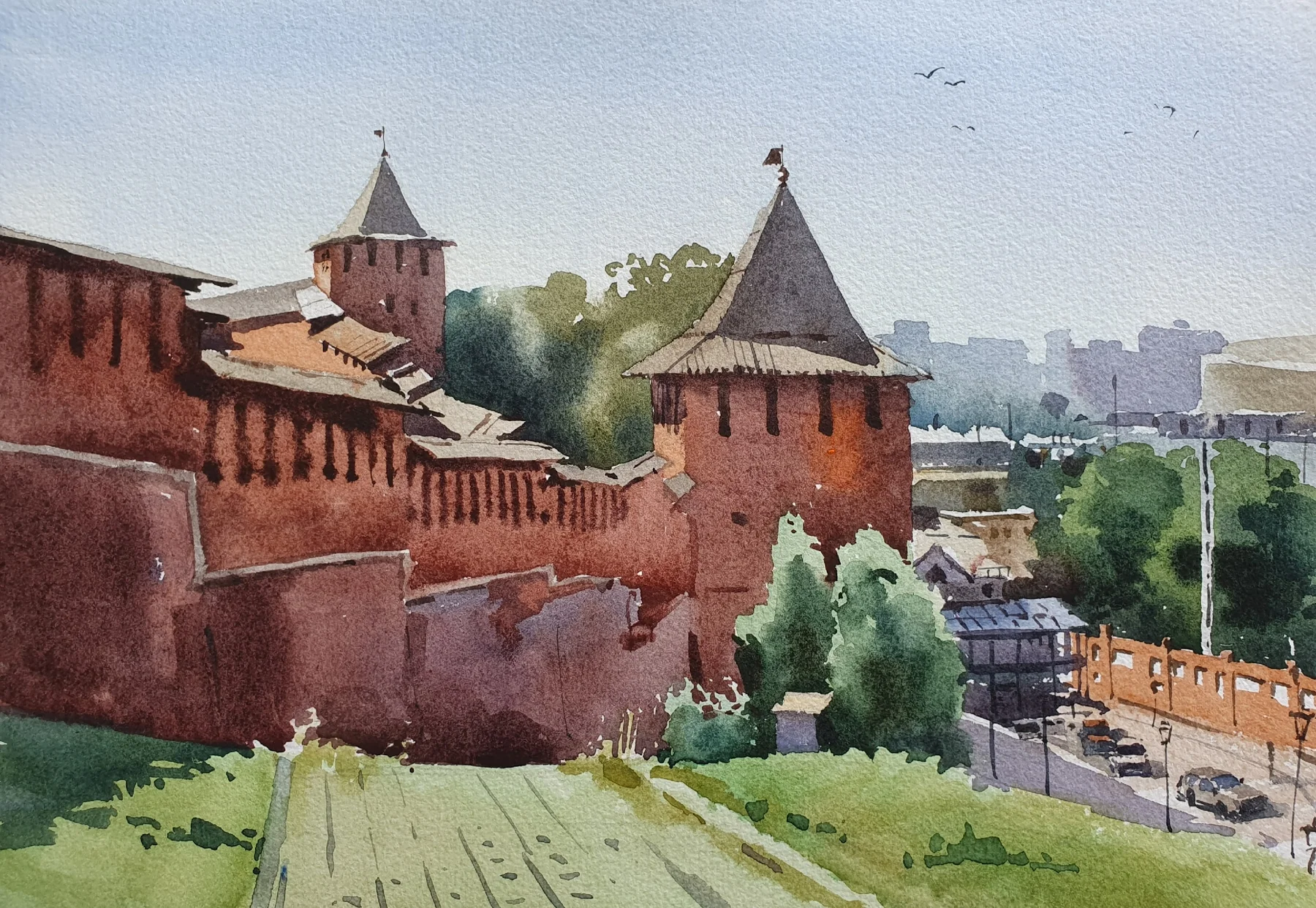
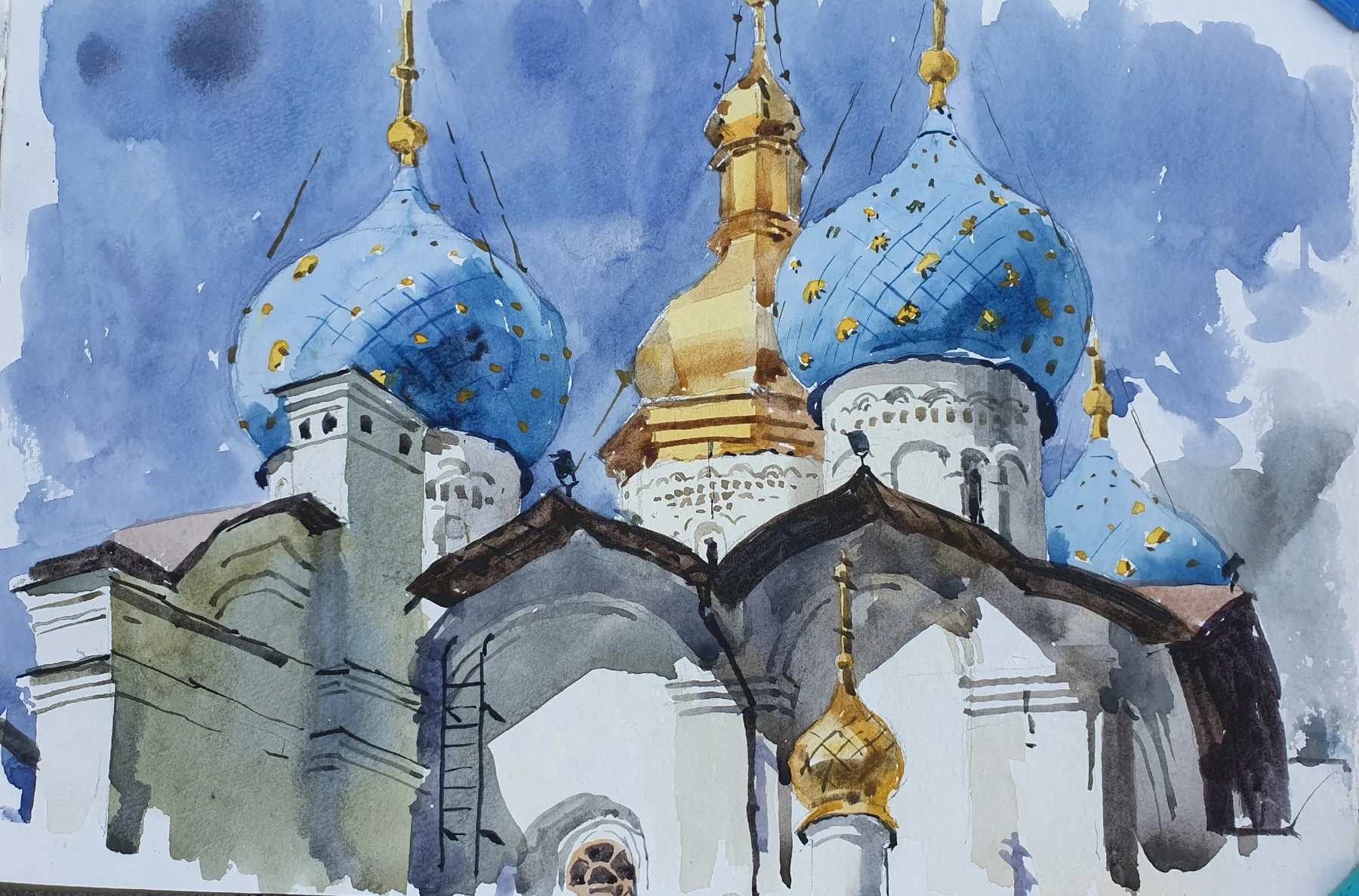
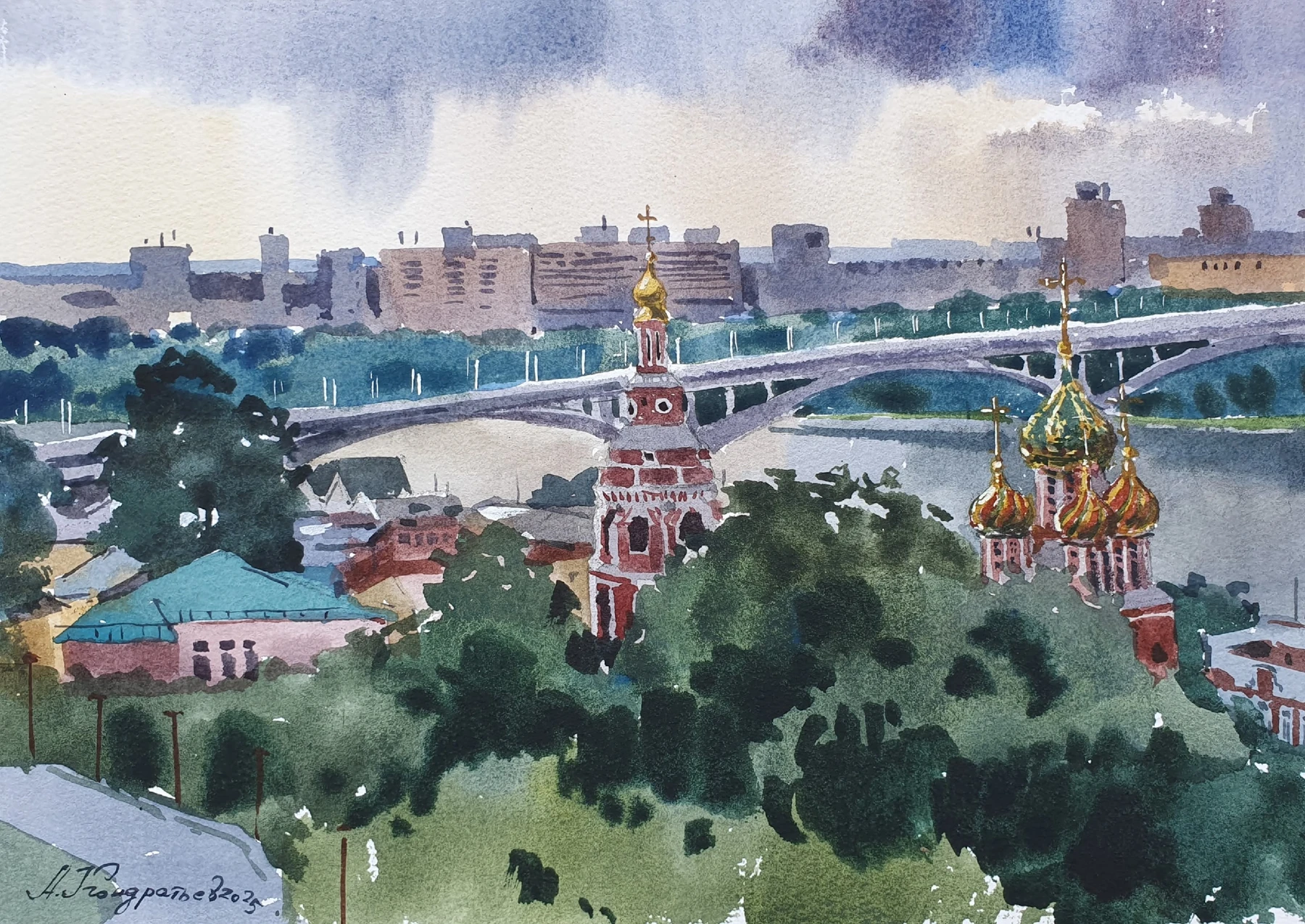
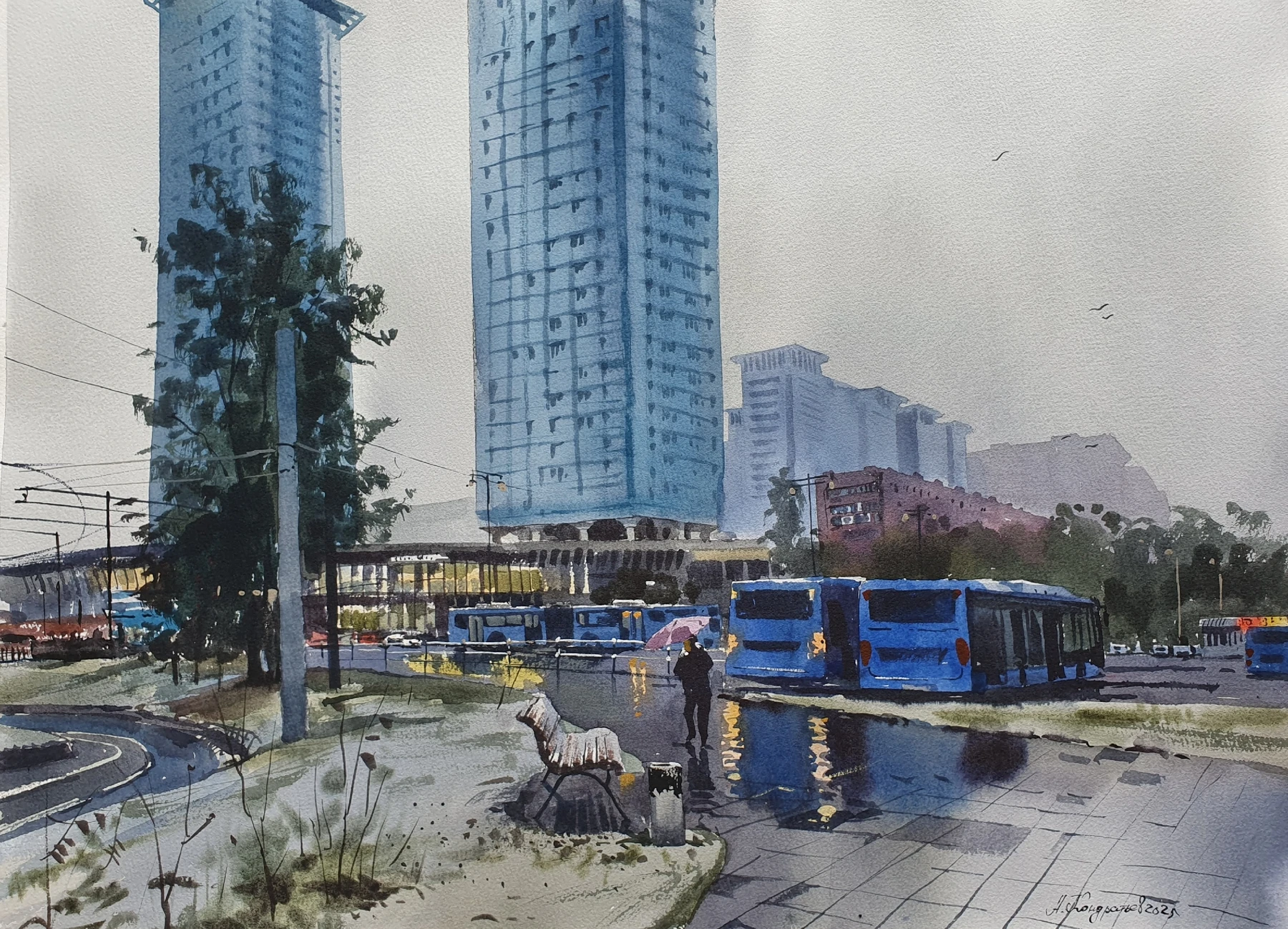
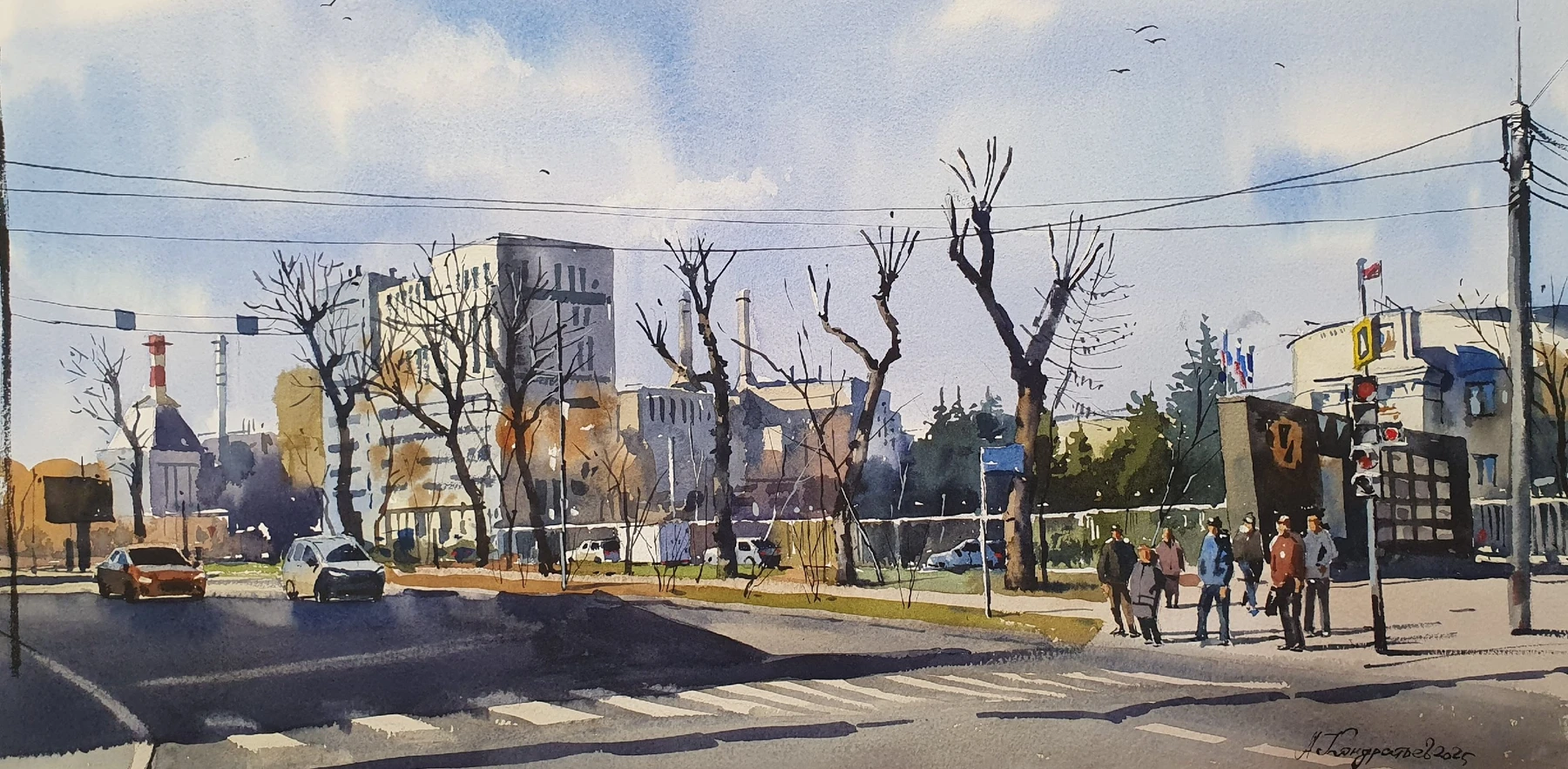
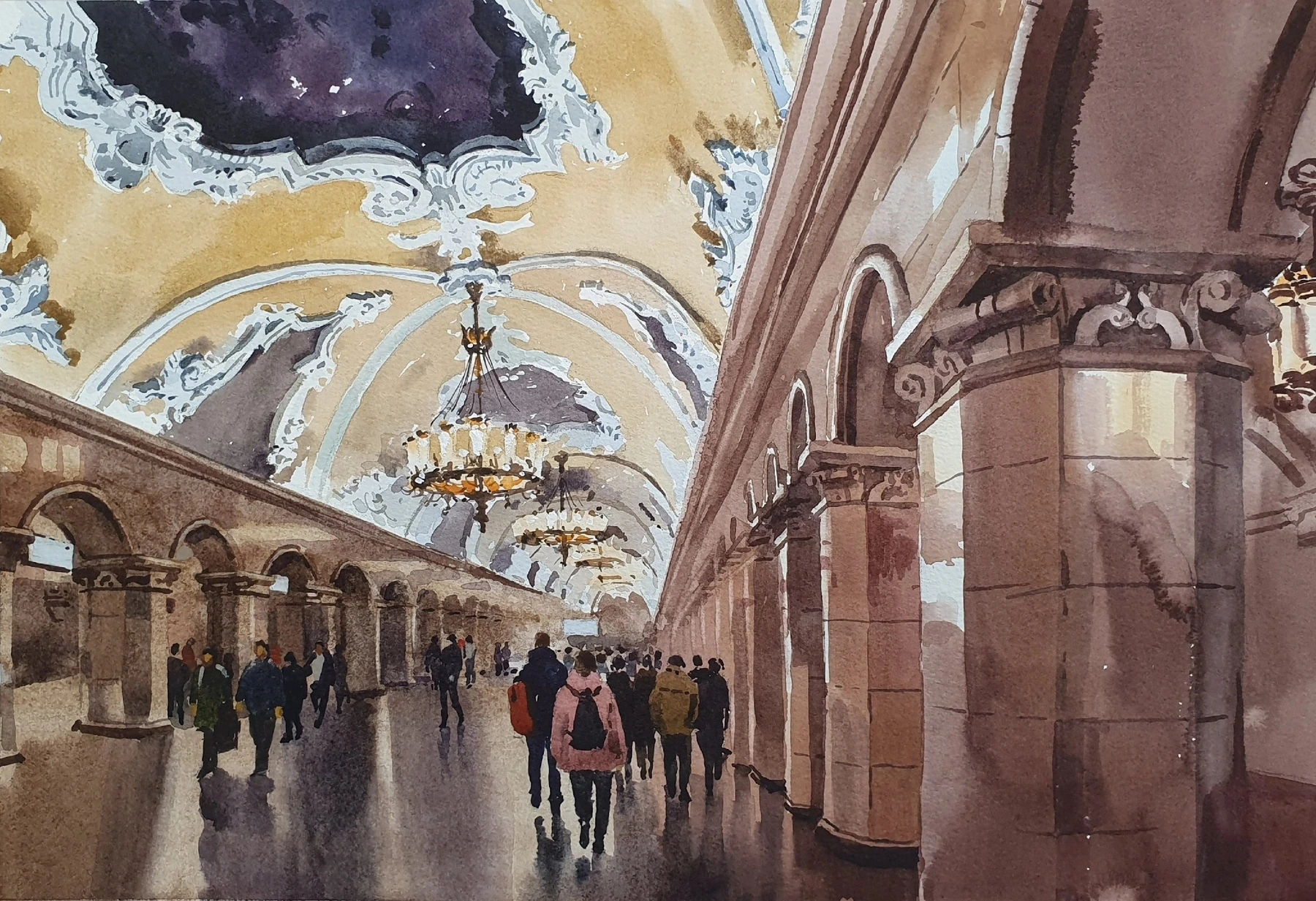
- Since 2019, I've been actively painting urban environments: in summer — from life en plein air, and in winter — still lifes in the studio and from my own photo references.
- An active member of the Urban Sketchers movement and the Chertanovo Art Association.
- Participant in numerous exhibitions.
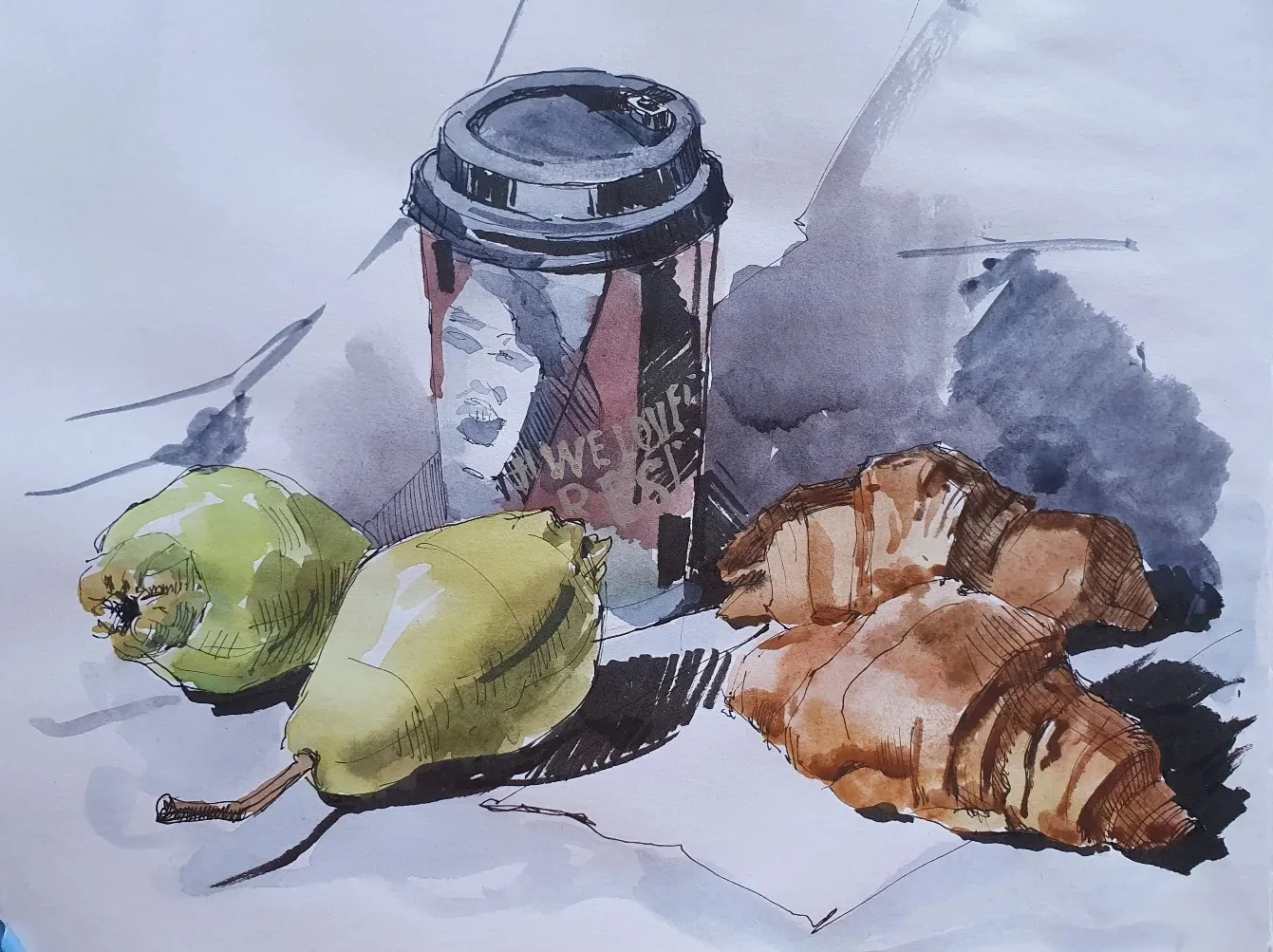
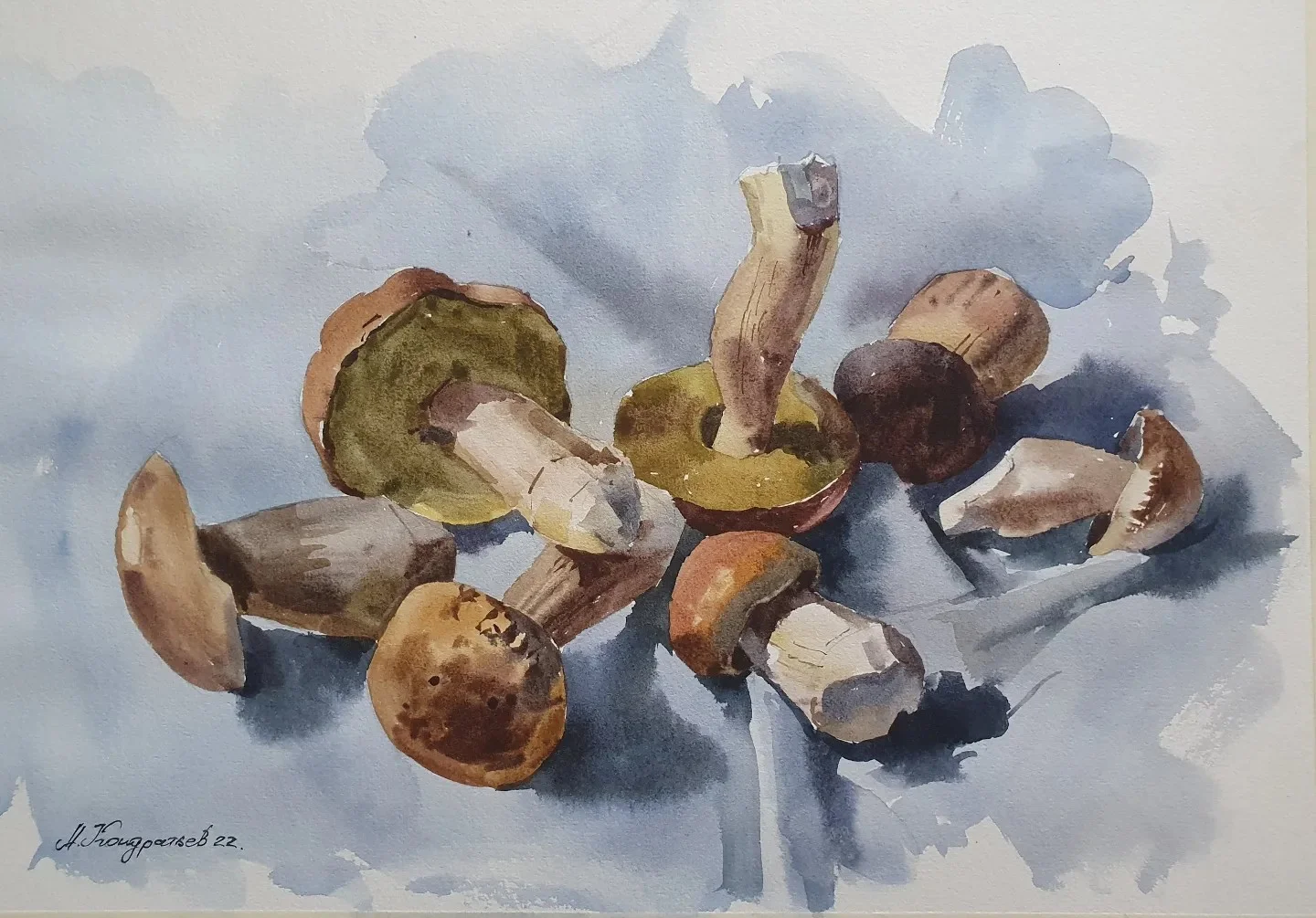
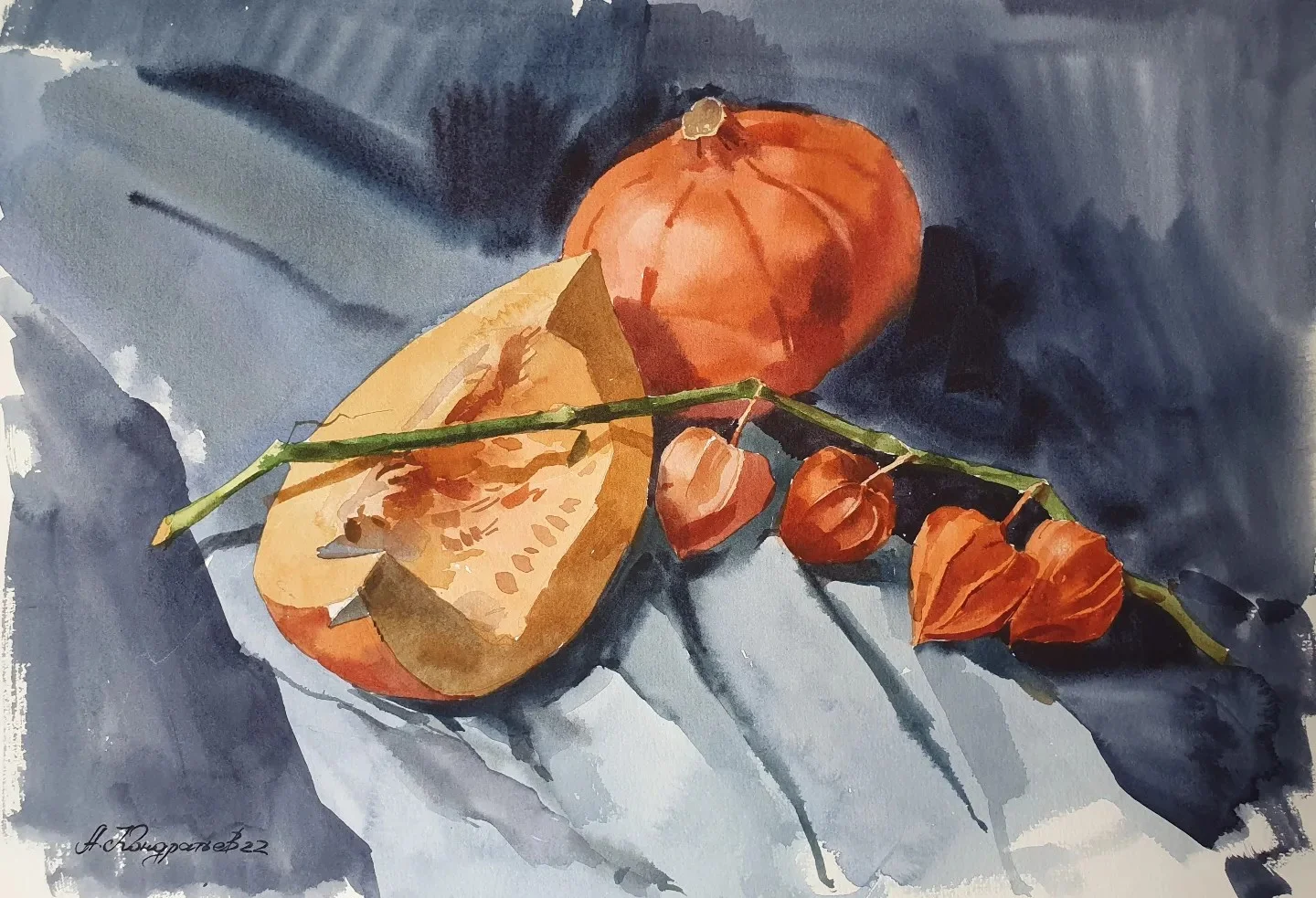
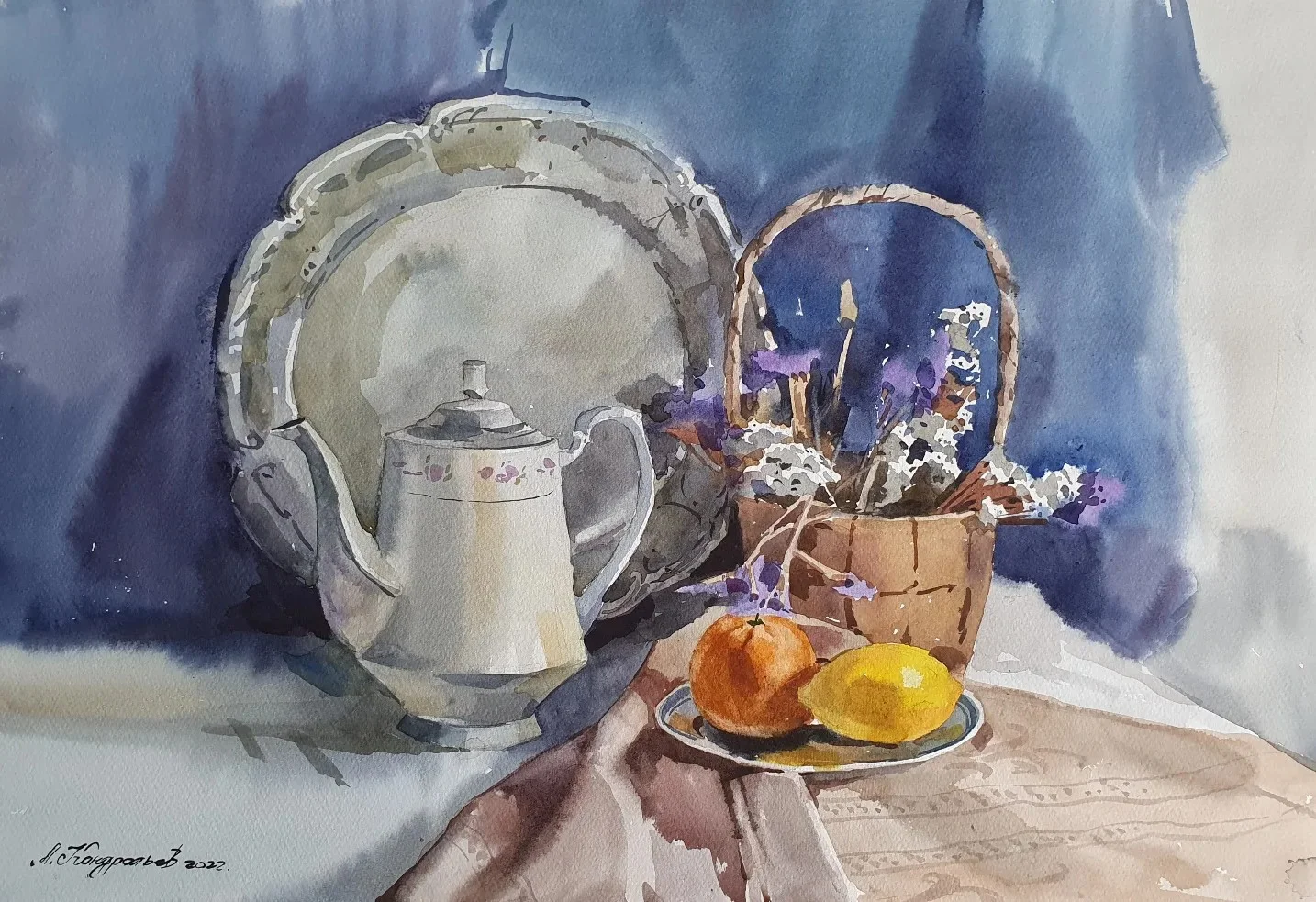
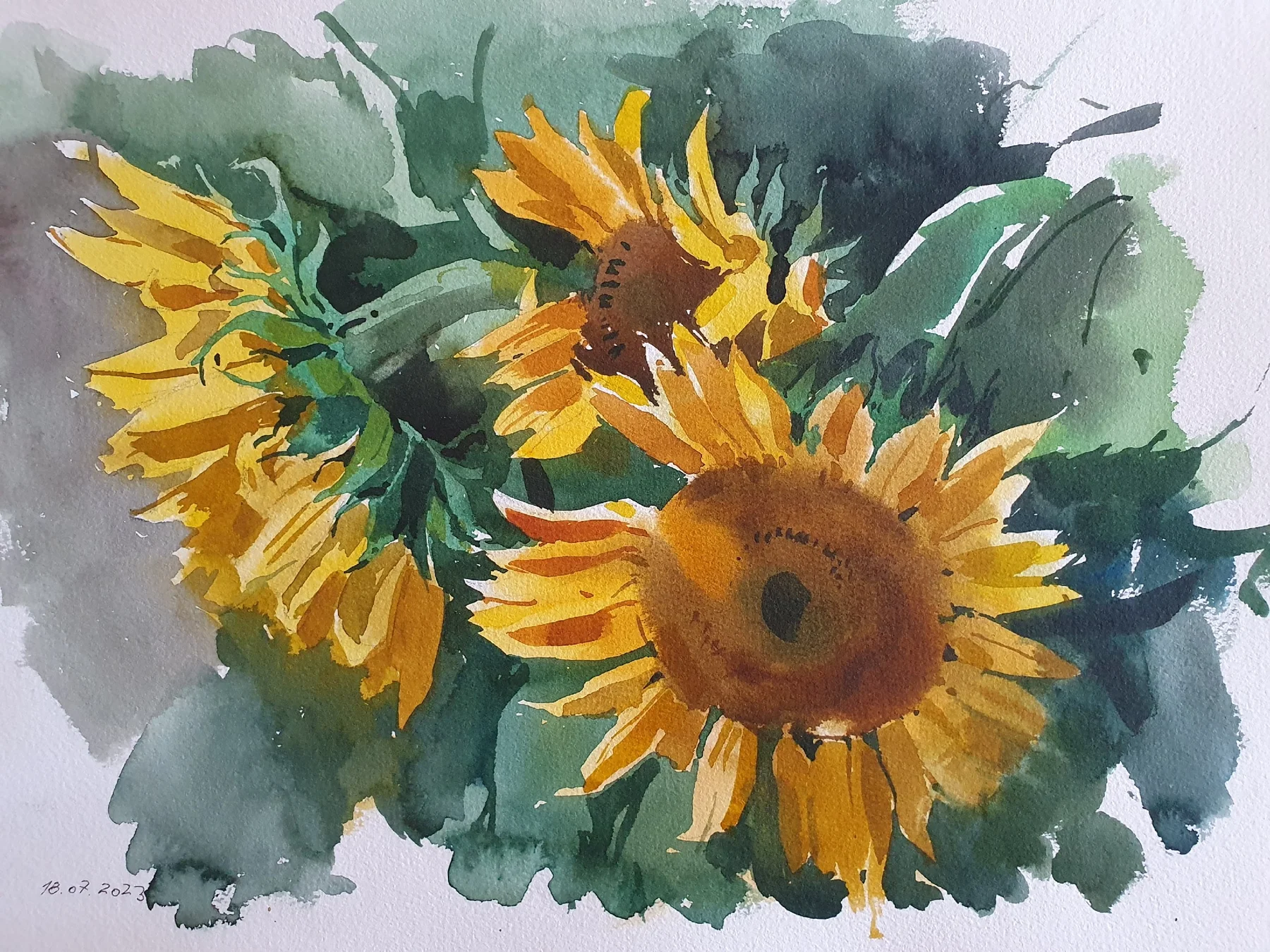
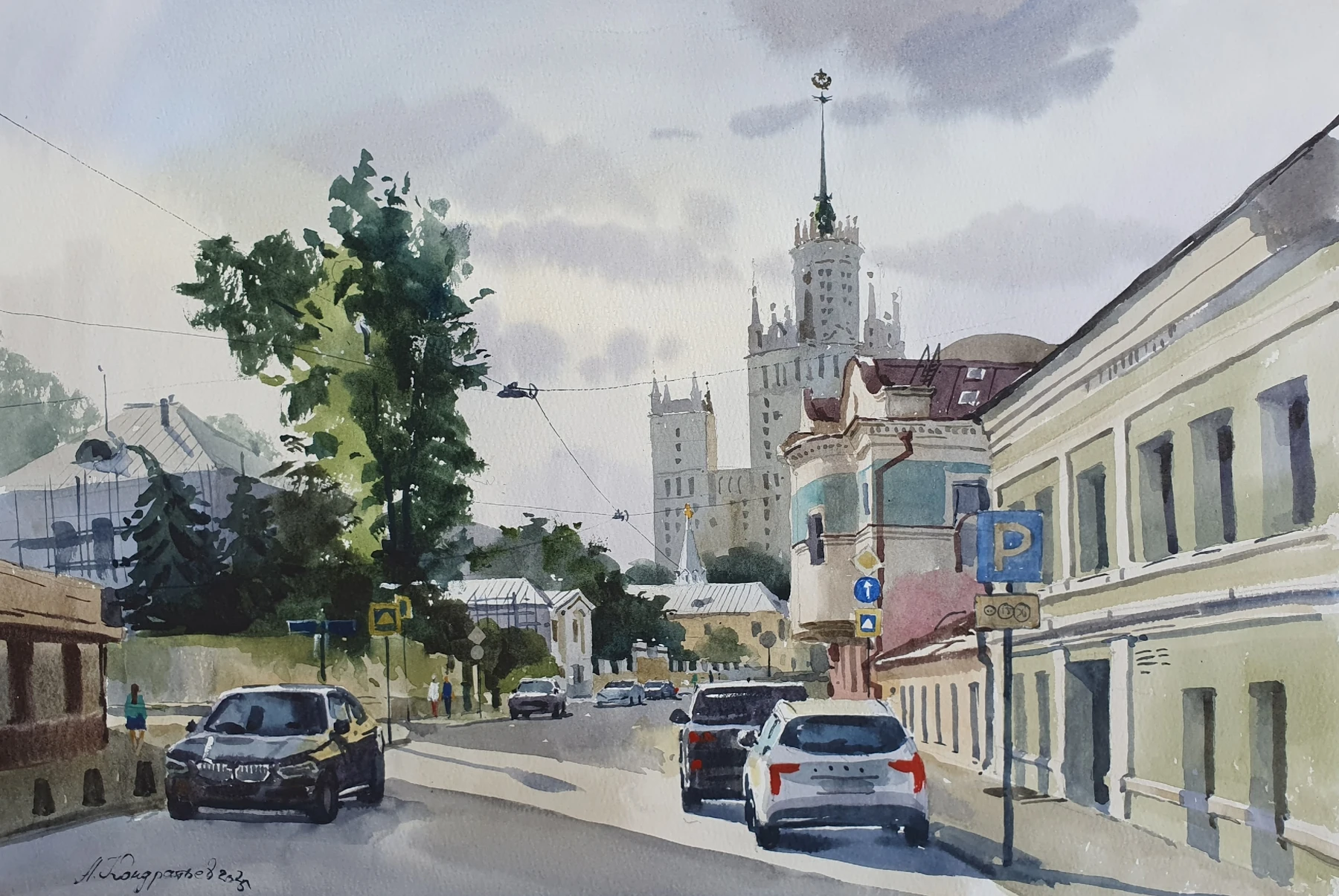
Works by Alexey Kondratyev
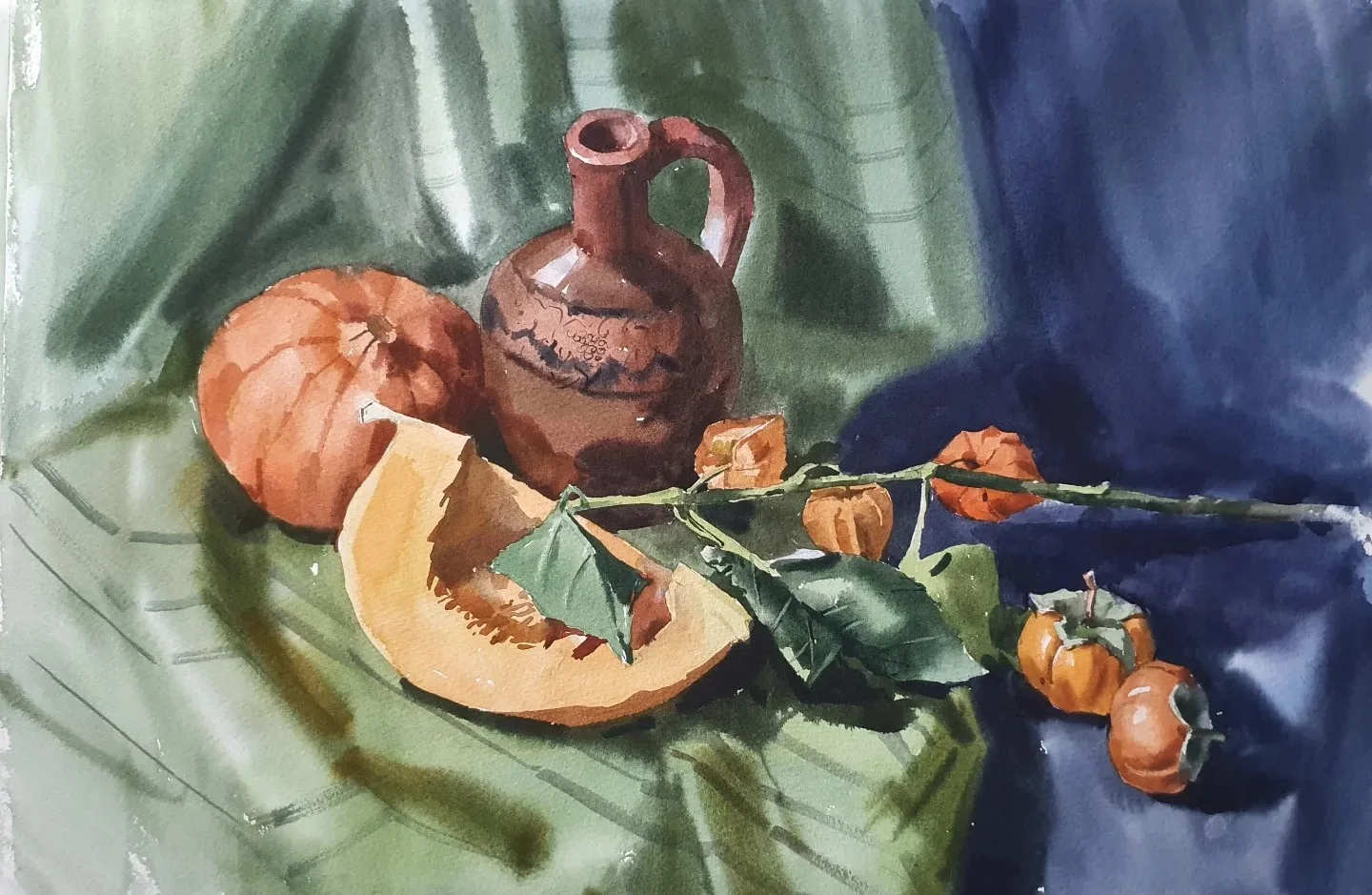
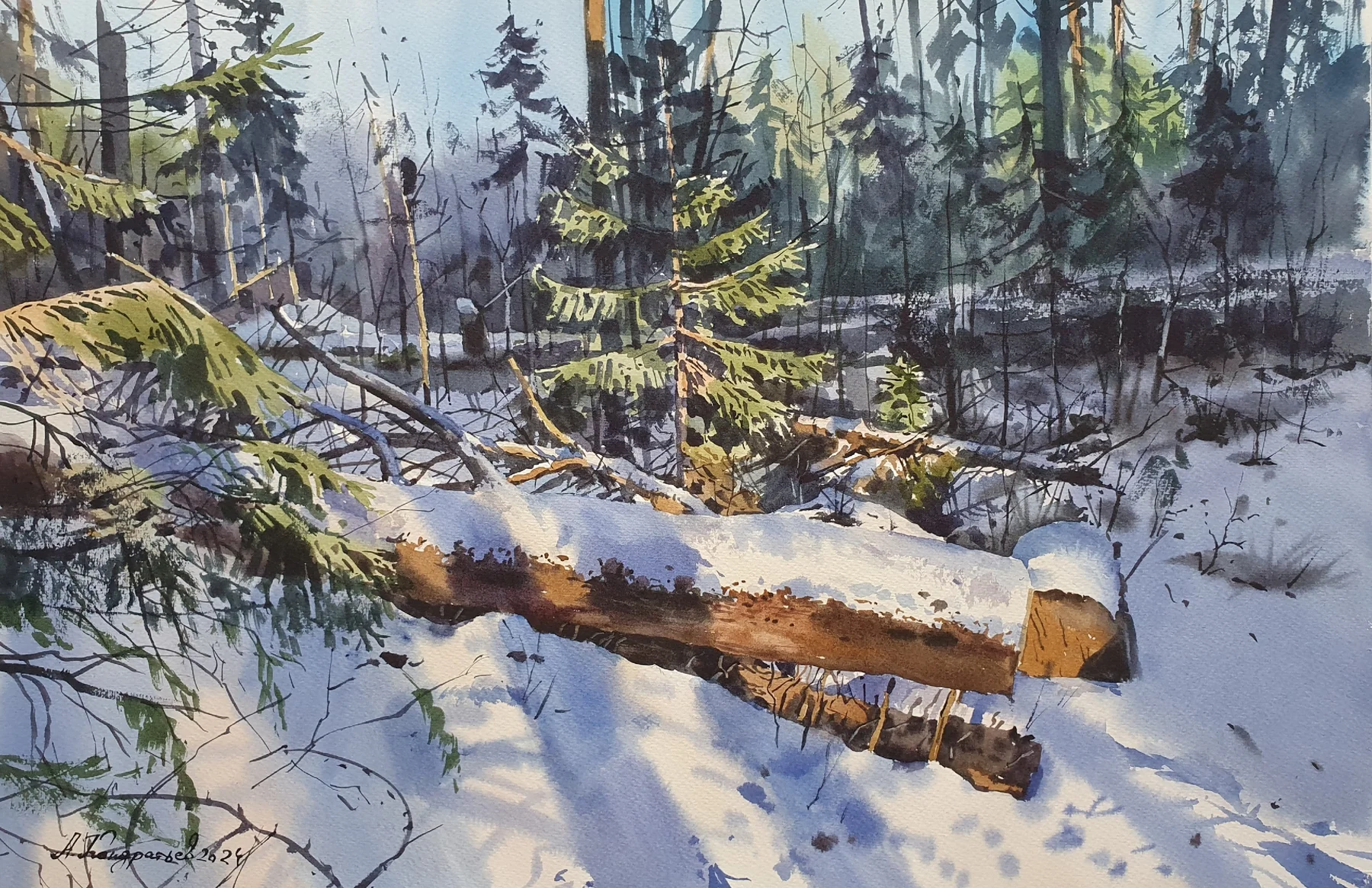
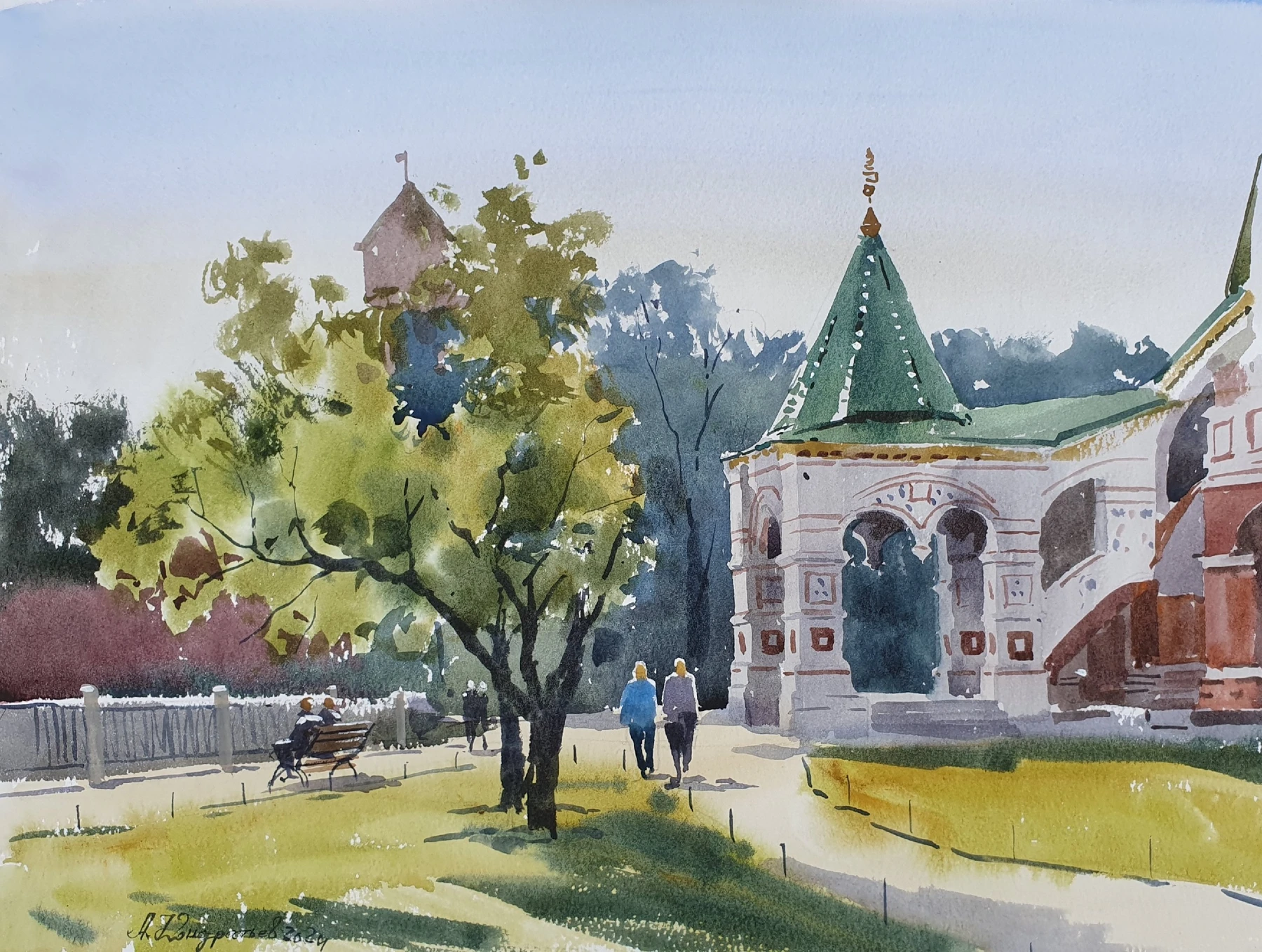
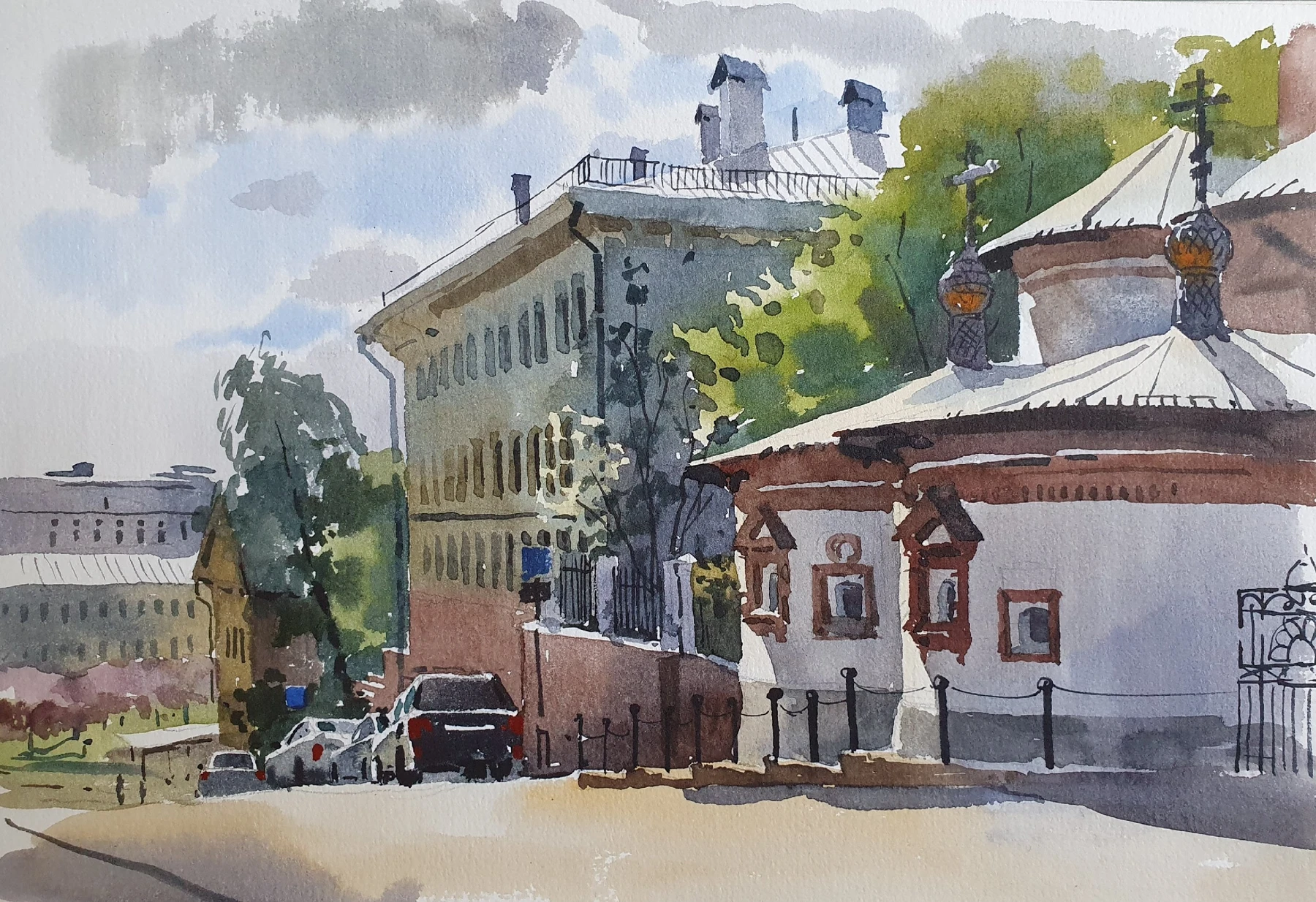
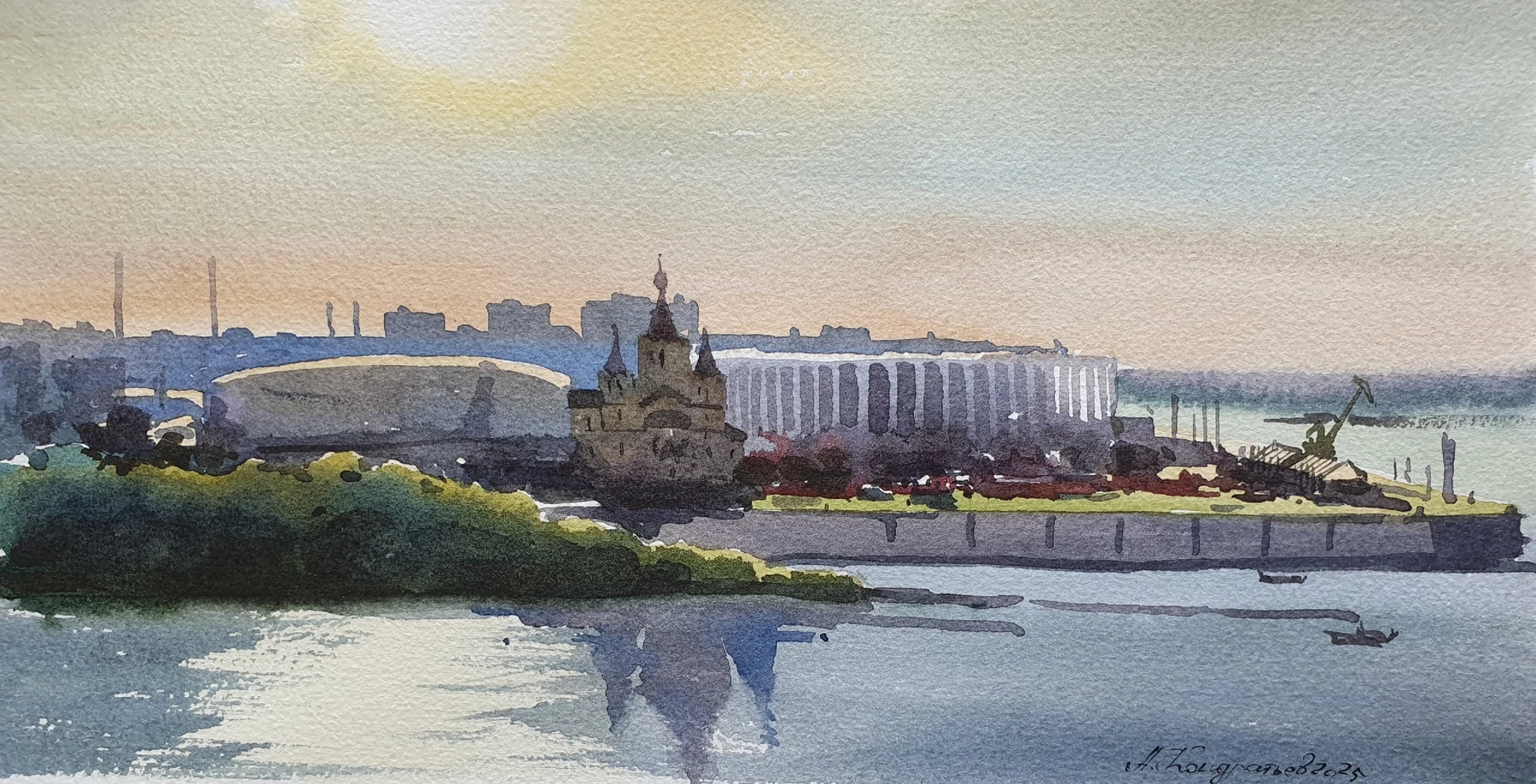
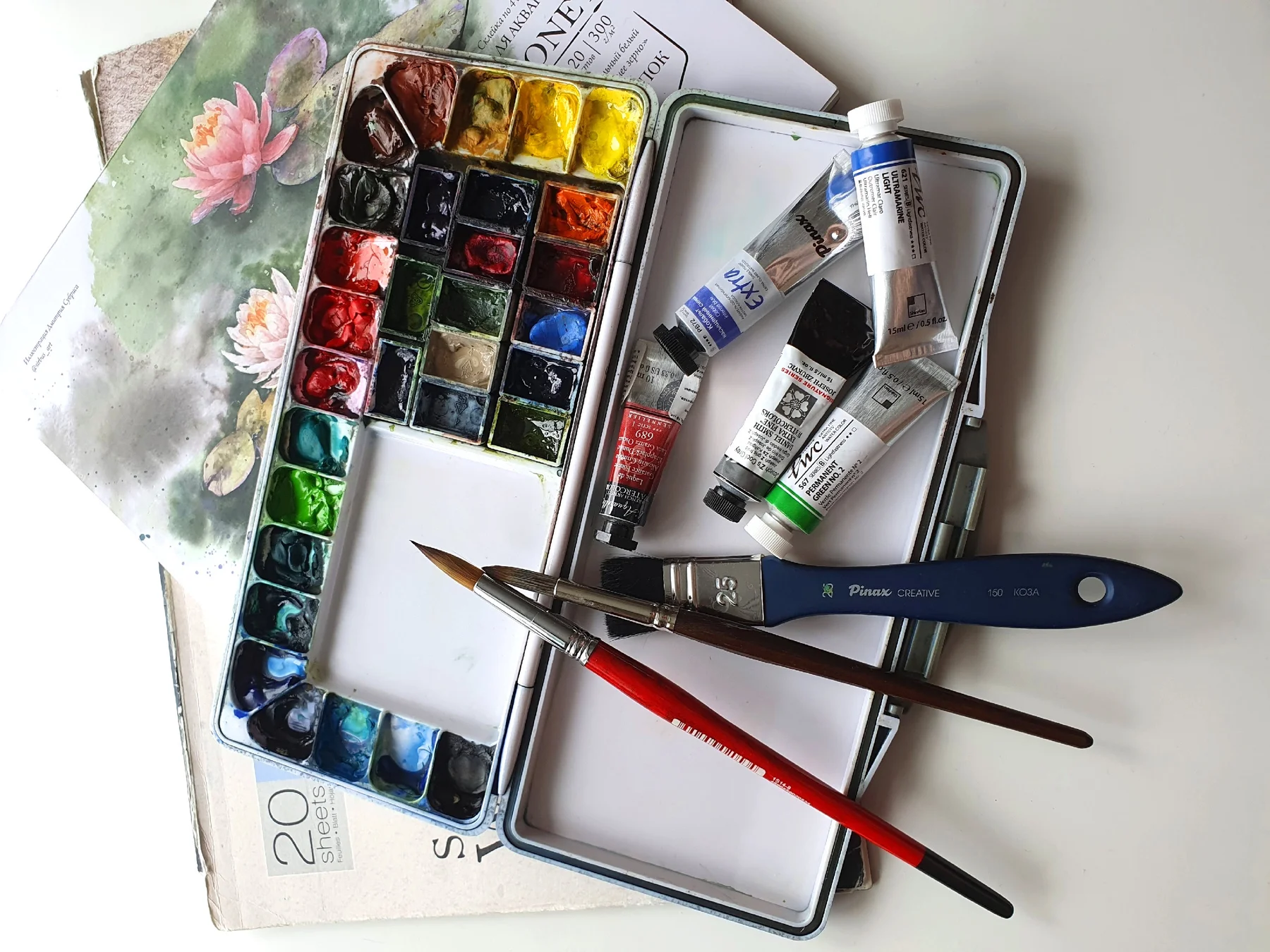
Course materials
Paper
- A3 (approx. 12" × 17"), 100% cotton, 300 gsm
- A3 (approx. 12" × 17"), regular drawing paper (1 sheet)
Brushes
Whatever works for you — natural, synthetic, or a mix:
- Flat brush 3–6 cm (apx. 1.2"–2.4")
- Round brushes: large, medium, and small
- Liner brush (a thin brush for details)
Paints
24–36 colors, any brand. These colors or their equivalents will work:
- Lemon Yellow
- Orange
- Yellow Ochre
- Red
- Dark Red (Madder Lake)
- Olive
- Light Green (May Green)
- Dark Green (Grass Green)
- Cobalt Blue
- Ultramarine
- Indigo or Indanthrone Blue
- Burnt Sienna
- Burnt Umber
- Warm Sepia
- Black (any)
Additional
- B or 2B pencil
- Eraser
- A3 (approx. 12" × 17") board
- Masking tape
- Water container
Choose Your Plan
- 8 expressive compositions featuring fruits, vegetables, and everyday objects
- 13 lessons: theory + practice + artistic tips and tricks
- "Course Unfreeze" — the option to start learning whenever the time is right for you
- Access to artwork analysis sessions from other participants
- Lifetime access to all course materials
- Review of your work and answers to your questions in the comments for 60 days from the moment you start the course
- A personal one-hour online consultation with the course expert
- +$20 in bonus dollars! Use them toward your next course purchase at a future marathon. They expire after 3 months
- Machine translated subtitles: English, German, French, Italian, Spanish, Greek, Polish, Portuguese, Hungarian, Chinese, Indonesian.
Frequently Asked Questions
Absolutely! Anyone can learn to paint! It's simply a skill that develops with practice. Our course is structured from simple to complex, so anyone can follow along — even with zero experience. Step by step, through hands-on practice as you create the paintings in the course, you'll build your skills and learn to paint.
At the end of the lesson, you'll upload a photo of your work. Your instructor will have the option to leave a text comment, a graphic comment (notes drawn directly on your painting), or an audio comment.
At the bottom of the final lesson there will be a comments section where you can ask any questions about the course.
If you're on a plan without feedback, it all depends on your own personal pace as you work through the lessons.
On plans with feedback, we actively work through the lessons over two months from the moment you "unfreeze" the course.
Overall, I recommend taking the course at a relaxed pace. Enjoy the process as much as possible.
Yes, this course is great for both beginners and those who already have some experience.
It's never too late to learn to paint. In our school, 30% of students are over 50. And they paint with joy, develop their skills, nurture their creativity, and feel younger in heart and mind!